
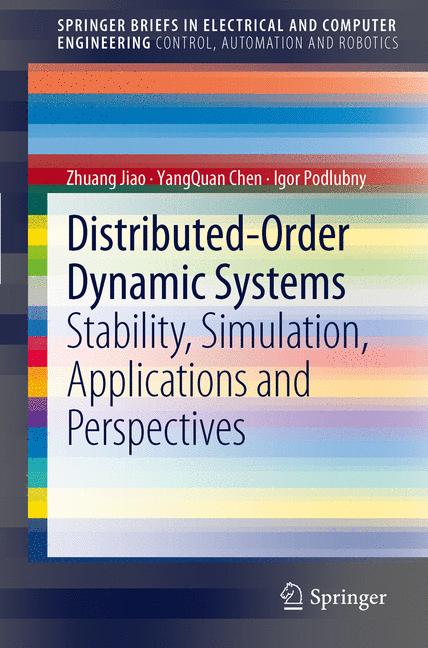
Distributed-Order Dynamic Systems
☆☆☆☆☆
(0 reviews)
Lowest price (incl. delivery)
7 149,00 JPY
Typical price524,37 PLN
Lowest (90 days)35,99 PLN
Offers6
Last updated1 hafta önce
Price history (90 days)
Full history
2026-08-08
2026-08-15
| Güncellenme Tarihi | Fiyat |
|---|---|
| 2026-08-08 | 39,99 |
| 2026-08-14 | 35,99 |
| 2026-08-15 | 51,99 |
| Satıcı | Product price | Delivery | Toplam | Stok Durumu | Updated | |
|---|---|---|---|---|---|---|
| SP SpringerNatureLink Shop INT | 7 149,00 JPY | free | 7 149,00 JPY | Mevcut | 5 gün önce | View offer |
| SP Springer Nature Author | 7 149,00 JPY | free | 7 149,00 JPY | Mevcut | 1 hafta önce | View offer |
| SP SpringerNatureLink Shop INT | 49,99 USD | 19,00 USD | 68,99 USD | Mevcut | 5 gün önce | View offer |
| SP SpringerNatureLink Shop INT | 54,99 USD | 29,00 USD | 83,99 USD | Mevcut | 5 gün önce | View offer |
| SP SpringerNatureLink Shop INT | 54,99 USD | 19,00 USD | 73,99 USD | Mevcut | 5 gün önce | View offer |
| SP SpringerNatureLink Shop INT | 59,00 EUR | free | 59,00 EUR | Mevcut | 5 gün önce | View offer |
Fiyatlar ve stok durumu değişebilir. Son Güncelleme: 08.08.2026 23:08.
0,0
☆☆☆☆☆
0 reviews
5★
0%
4★
0%
3★
0%
2★
0%
1★
0%
Product reviews
No reviews yet — be the first!
Distributed-order differential equations, a generalization of fractional calculus, are of increasing importance in many fields of science and engineering from the behaviour of complex dielectric media to the modelling of nonlinear systems. This Brief will broaden the toolbox available to researchers interested in modeling, analysis, control and filtering. It contains contextual material outlining the progression from integer-order, through fractional-order to distributed-order systems. Stability issues are addressed with graphical and numerical results highlighting the fundamental differences between constant-, integer-, and distributed-order treatments. The power of the distributed-order model is demonstrated with work on the stability of noncommensurate-order linear time-invariant systems. Generic applications of the distributed-order operator follow: signal processing and viscoelastic damping of a mass–spring set up. A new general approach to discretization of distributed-order derivatives and integrals is described. The Brief is rounded out with a consideration of likely future research and applications and with a number of MATLAB® codes to reduce repetitive coding tasks and encourage new workers in distributed-order systems.
Similar products
 50 Years of Philosophy and Medicine
from $107.30
50 Years of Philosophy and Medicine
from $107.30
 Understanding Cybersecurity Law and Digital Privacy
from $122.63
Understanding Cybersecurity Law and Digital Privacy
from $122.63
 Decisions in International Trade and Logistics
from $122.63
Decisions in International Trade and Logistics
from $122.63
 Advances in Economic Measurement
from $122.63
Advances in Economic Measurement
from $122.63
 Nanomaterials
from $137.96
Nanomaterials
from $137.96
 Sustainable Scaffolds-based Strategies in Tissue Engineering and Regenerative Medicine
from $162.87
Sustainable Scaffolds-based Strategies in Tissue Engineering and Regenerative Medicine
from $162.87
 Narratives in Educational Research
from $162.87
Narratives in Educational Research
from $162.87
 Environmental Biology of the Young Chinese Sturgeon
from $210.78
Environmental Biology of the Young Chinese Sturgeon
from $210.78