
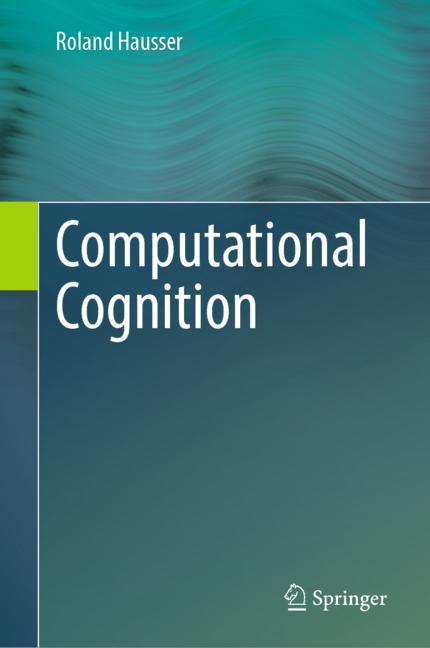
Computational Cognition
☆☆☆☆☆
(0 reviews)
Lowest price (incl. delivery)
20 620,00 JPY
Typical price20 591,00 PLN
Lowest (90 days)20 591,00 PLN
Offers3
Last updated5 gün önce
| Satıcı | Product price | Delivery | Toplam | Stok Durumu | Updated | |
|---|---|---|---|---|---|---|
| SP SpringerNatureLink Shop INT | 20 591,00 JPY | 29,00 JPY | 20 620,00 JPY | Mevcut | 5 gün önce | View offer |
| SP Springer Nature Author | 20 591,00 JPY | free | 20 591,00 JPY | Mevcut | 1 hafta önce | View offer |
| SP SpringerNatureLink Shop INT | 127,50 GBP | 15,00 GBP | 142,50 GBP | Mevcut | 5 gün önce | View offer |
Fiyatlar ve stok durumu değişebilir. Son Güncelleme: 15.08.2026 04:42.
EAN
9783031374999
Springer Nature
0,0
☆☆☆☆☆
0 reviews
5★
0%
4★
0%
3★
0%
2★
0%
1★
0%
Product reviews
No reviews yet — be the first!
Modern science is divided into three parts: natural sciences, engineering sciences and humanities. Over the last millennia, natural and engineering sciences evolved a symbiotic relationship, but humanities still stand apart. Today, however, designing and building a talking robot is a comparatively new challenge for which all three branches are needed. Starting from the idea that designing a theory of computational cognition should be as complete as possible, and trying to answer questions such as “Which ontology is required for building a computational cognition?”, the current book integrates interfaces, components, functional flows, data structure, database schema, and algorithms into a coherent system with an extensive range of cognitive functions, and constitutes the background to the book “Ontology of Communication” recently published by the author (Springer, 2023). Part I discusses ontological distinctions between a sign-based and an agent-based approach, and continues with explanations of the data structure, the content-addressable database schema; the time-linear derivations of the speak and the hear mode; resonating content; induction, deduction, and abduction in inferencing, and concludes with a reconstruction of eight classical syllogisms as a test suite for DBS inferencing in the think mode. Part II complements the literal use of language in the speak and hear mode with a reconstruction of syntactic mood adaptations and figurative use. The database schema of DBS is shown to lend itself not only to the tasks of traditional storage and retrieval, but also of reference, coreference, shadowing, coactivation of resonating content, and selective activation. Part III complements the treatment of individual topics in linguistics, philosophy, and cognitive psychology with an overall software structure in the form of three interacting main components, called the interface, the memory, and the production component.
Similar products
 50 Years of Philosophy and Medicine
from $107.30
50 Years of Philosophy and Medicine
from $107.30
 Understanding Cybersecurity Law and Digital Privacy
from $122.63
Understanding Cybersecurity Law and Digital Privacy
from $122.63
 Decisions in International Trade and Logistics
from $122.63
Decisions in International Trade and Logistics
from $122.63
 Advances in Economic Measurement
from $122.63
Advances in Economic Measurement
from $122.63
 Nanomaterials
from $137.96
Nanomaterials
from $137.96
 Sustainable Scaffolds-based Strategies in Tissue Engineering and Regenerative Medicine
from $162.87
Sustainable Scaffolds-based Strategies in Tissue Engineering and Regenerative Medicine
from $162.87
 Narratives in Educational Research
from $162.87
Narratives in Educational Research
from $162.87
 Environmental Biology of the Young Chinese Sturgeon
from $210.78
Environmental Biology of the Young Chinese Sturgeon
from $210.78