
Cellulosic Materials
☆☆☆☆☆
(0 reviews)
Lowest price (incl. delivery)
21 464,00 JPY
Typical price3 268,59 PLN
Lowest (90 days)155,99 PLN
Offers6
Last updated1 hafta önce
Price history (90 days)
Full history
2026-08-08
2026-08-15
| Güncellenme Tarihi | Fiyat |
|---|---|
| 2026-08-08 | 155,99 |
| 2026-08-15 | 155,99 |
| Satıcı | Product price | Delivery | Toplam | Stok Durumu | Updated | |
|---|---|---|---|---|---|---|
| SP SpringerNatureLink Shop INT | 21 449,00 JPY | 15,00 JPY | 21 464,00 JPY | Mevcut | 6 gün önce | View offer |
| SP Springer Nature Author | 21 449,00 JPY | free | 21 449,00 JPY | Mevcut | 1 hafta önce | View offer |
| SP SpringerNatureLink Shop INT | 149,99 USD | 29,00 USD | 178,99 USD | Mevcut | 6 gün önce | View offer |
| SP SpringerNatureLink Shop INT | 169,99 USD | 15,00 USD | 184,99 USD | Mevcut | 6 gün önce | View offer |
| SP SpringerNatureLink Shop INT | 169,99 USD | 29,00 USD | 198,99 USD | Mevcut | 6 gün önce | View offer |
| SP SpringerNatureLink Shop INT | 177,00 EUR | free | 177,00 EUR | Mevcut | 6 gün önce | View offer |
Fiyatlar ve stok durumu değişebilir. Son Güncelleme: 08.08.2026 23:34.
0,0
☆☆☆☆☆
0 reviews
5★
0%
4★
0%
3★
0%
2★
0%
1★
0%
Product reviews
No reviews yet — be the first!
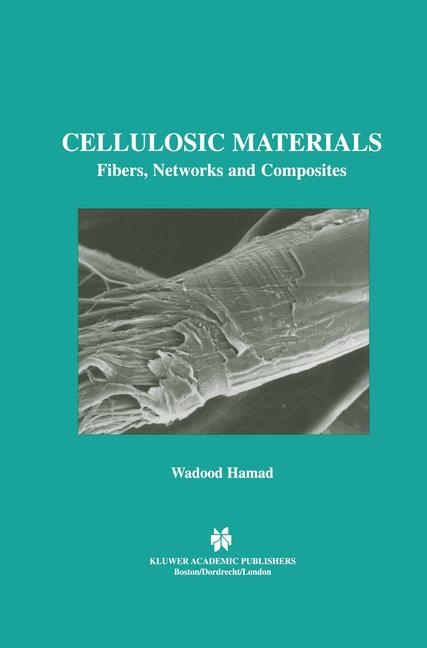
The objectives of this book are twofold: 1. To provide a thorough examination of the materials science of cellulosic fibers with emphasis on the characterization of structure-property relations, and 2. To advance knowledge of how to best analyze cellulosic fibrous networks and composites, and, ultimately, engineer "novel" cellulose-based systems of superior performance and functionality. The design of new materials through the study of living systems, or bio-imitation, is burgeoning to become an established field, generally referred to as biomimetics. The latter, as with materials science, in general, prominently features multi-disciplinarity where new developments in mathematics, physics, chemistry and engineering continue to inspire novel areas of research and development. The book is structured in five chapters which provide a sequential treatment of the running theme: deformation mechanics and the physical, morphological and mechanical characterization of native cellulose fibers networks and composites. The heart of the book is Chapter 3, Damage Accumulation in Fibers, which treats the experimental methodology for fatigue testing of single fibers and the engendered results. In-depth examinations of the morphology, structure and chemical composition of native cellulose fibers, and the mechanics of deformation in these natural composite fibers are proffered in Chapters 1 and 2, respectively. The fourth chapter, Fractal Simulation of Crack Propagation, presents a fractal-based approach to modeling damage accumulation in materials. Fractals lend themselves well to modeling such randomly-oriented phenomena as crack propagation and fracture. The last chapter, Fibrous Structures: Networks and Composites, comprises analytical approaches for handling networks and composites.
Similar products
 50 Years of Philosophy and Medicine
from $107.30
50 Years of Philosophy and Medicine
from $107.30
 Understanding Cybersecurity Law and Digital Privacy
from $122.63
Understanding Cybersecurity Law and Digital Privacy
from $122.63
 Decisions in International Trade and Logistics
from $122.63
Decisions in International Trade and Logistics
from $122.63
 Advances in Economic Measurement
from $122.63
Advances in Economic Measurement
from $122.63
 Nanomaterials
from $137.96
Nanomaterials
from $137.96
 Sustainable Scaffolds-based Strategies in Tissue Engineering and Regenerative Medicine
from $162.87
Sustainable Scaffolds-based Strategies in Tissue Engineering and Regenerative Medicine
from $162.87
 Narratives in Educational Research
from $162.87
Narratives in Educational Research
from $162.87
 Environmental Biology of the Young Chinese Sturgeon
from $210.78
Environmental Biology of the Young Chinese Sturgeon
from $210.78