
Bandit problems
☆☆☆☆☆
(0 reviews)
Lowest price (incl. delivery)
15 758,00 JPY
Typical price1 476,60 PLN
Lowest (90 days)99,99 PLN
Offers6
Last updated1 hafta önce
Price history (90 days)
Full history
2026-08-08
2026-08-15
| Güncellenme Tarihi | Fiyat |
|---|---|
| 2026-08-08 | 109,99 |
| 2026-08-15 | 99,99 |
| Satıcı | Product price | Delivery | Toplam | Stok Durumu | Updated | |
|---|---|---|---|---|---|---|
| SP SpringerNatureLink Shop INT | 15 729,00 JPY | 29,00 JPY | 15 758,00 JPY | Mevcut | 5 gün önce | View offer |
| SP Springer Nature Author | 15 729,00 JPY | free | 15 729,00 JPY | Mevcut | 1 hafta önce | View offer |
| SP SpringerNatureLink Shop INT | 109,99 USD | 29,00 USD | 138,99 USD | Mevcut | 5 gün önce | View offer |
| SP SpringerNatureLink Shop INT | 119,99 USD | 19,00 USD | 138,99 USD | Mevcut | 5 gün önce | View offer |
| SP SpringerNatureLink Shop INT | 119,99 USD | 19,00 USD | 138,99 USD | Mevcut | 5 gün önce | View offer |
| SP SpringerNatureLink Shop INT | 130,00 EUR | 19,00 EUR | 149,00 EUR | Mevcut | 5 gün önce | View offer |
Fiyatlar ve stok durumu değişebilir. Son Güncelleme: 08.08.2026 23:26.
0,0
☆☆☆☆☆
0 reviews
5★
0%
4★
0%
3★
0%
2★
0%
1★
0%
Product reviews
No reviews yet — be the first!
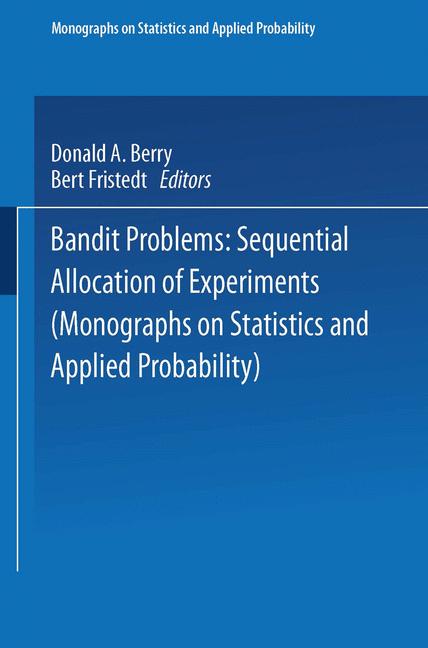
Our purpose in writing this monograph is to give a comprehensive treatment of the subject. We define bandit problems and give the necessary foundations in Chapter 2. Many of the important results that have appeared in the literature are presented in later chapters; these are interspersed with new results. We give proofs unless they are very easy or the result is not used in the sequel. We have simplified a number of arguments so many of the proofs given tend to be conceptual rather than calculational. All results given have been incorporated into our style and notation. The exposition is aimed at a variety of types of readers. Bandit problems and the associated mathematical and technical issues are developed from first principles. Since we have tried to be comprehens ive the mathematical level is sometimes advanced; for example, we use measure-theoretic notions freely in Chapter 2. But the mathema tically uninitiated reader can easily sidestep such discussion when it occurs in Chapter 2 and elsewhere. We have tried to appeal to graduate students and professionals in engineering, biometry, econ omics, management science, and operations research, as well as those in mathematics and statistics. The monograph could serve as a reference for professionals or as a telA in a semester or year-long graduate level course.
Similar products
 50 Years of Philosophy and Medicine
from $107.30
50 Years of Philosophy and Medicine
from $107.30
 Understanding Cybersecurity Law and Digital Privacy
from $122.63
Understanding Cybersecurity Law and Digital Privacy
from $122.63
 Decisions in International Trade and Logistics
from $122.63
Decisions in International Trade and Logistics
from $122.63
 Advances in Economic Measurement
from $122.63
Advances in Economic Measurement
from $122.63
 Nanomaterials
from $137.96
Nanomaterials
from $137.96
 Sustainable Scaffolds-based Strategies in Tissue Engineering and Regenerative Medicine
from $162.87
Sustainable Scaffolds-based Strategies in Tissue Engineering and Regenerative Medicine
from $162.87
 Narratives in Educational Research
from $162.87
Narratives in Educational Research
from $162.87
 Environmental Biology of the Young Chinese Sturgeon
from $210.78
Environmental Biology of the Young Chinese Sturgeon
from $210.78