
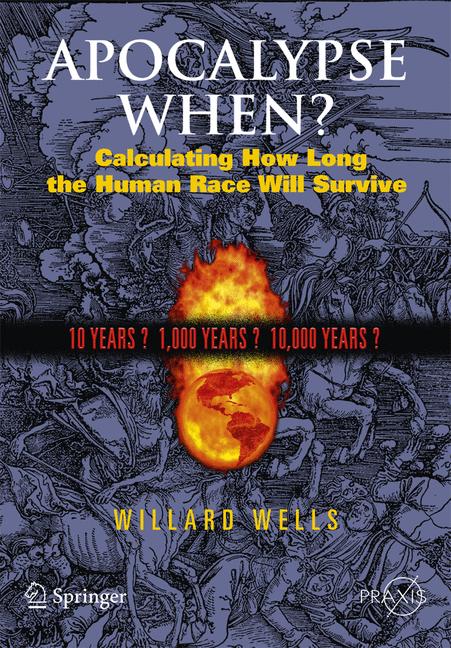
Apocalypse When?
☆☆☆☆☆
(0 reviews)
Lowest price (incl. delivery)
4 438,00 JPY
Typical price96,11 PLN
Lowest (90 days)14,42 PLN
Offers5
Last updated1 hafta önce
Price history (90 days)
Full history
2026-08-07
2026-08-14
| Güncellenme Tarihi | Fiyat |
|---|---|
| 2026-08-07 | 14,42 |
| 2026-08-08 | 22,99 |
| 2026-08-14 | 30,83 |
| Satıcı | Product price | Delivery | Toplam | Stok Durumu | Updated | |
|---|---|---|---|---|---|---|
| SP Springer Nature Author | 4 409,00 JPY | 29,00 JPY | 4 438,00 JPY | Mevcut | 1 hafta önce | View offer |
| SP SpringerNatureLink Shop INT | 30,83 USD | 25,00 USD | 55,83 USD | Mevcut | 4 gün önce | View offer |
| SP SpringerNatureLink Shop INT | 30,83 USD | 15,00 USD | 45,83 USD | Mevcut | 4 gün önce | View offer |
| VI VitalSource | 32,09 EUR | 29,00 EUR | 61,09 EUR | Mevcut | 1 hafta önce | View offer |
| SP SpringerNatureLink Shop INT | 33,91 EUR | 25,00 EUR | 58,91 EUR | Mevcut | 4 gün önce | View offer |
Fiyatlar ve stok durumu değişebilir. Son Güncelleme: 08.08.2026 08:01.
EAN
9780387098364
Springer Nature
0,0
☆☆☆☆☆
0 reviews
5★
0%
4★
0%
3★
0%
2★
0%
1★
0%
Product reviews
No reviews yet — be the first!
This book will be a key trailblazer in a new and upcoming field. The author’s predictive approach relies on simple and intuitive probability formulations that will appeal to readers with a modest knowledge of astronomy, mathematics, and statistics. Wells’ carefully erected theory stands on a sure footing and thus should serve as the basis of many rational predictions of survival in the face of not only natural disasters such as hits by asteroids or comets, but perhaps more surprisingly from man-made hazards arising from genetic engineering or robotics. Any formula for predicting human survival will invite controversy. Dr Wells counters anticipated criticism with a thorough approach in which four lines of reasoning are used to arrive at the same survival formula. One uses empirical survival statistics for business firms and stage shows. Another is based on uncertainty of risk rates. The third, more abstract, invokes Laplace’s principle of insufficient reason and involves an observer’s random arrival in the lifetime of the entity (the human race) in question. The fourth uses Bayesian theory. The author carefully explains and gives examples of the conditions under which his principle is valid and provides evidence that can counteract the arguments of critics who would reject it entirely. His deflection of possible criticisms results from two major premises: selecting the proper random variable and “reference class” to make predictions, and the recognition that if one does not know the law that governs a process, then the best prediction that can be made is his own formula.
Similar products
 50 Years of Philosophy and Medicine
from $107.30
50 Years of Philosophy and Medicine
from $107.30
 Understanding Cybersecurity Law and Digital Privacy
from $122.63
Understanding Cybersecurity Law and Digital Privacy
from $122.63
 Decisions in International Trade and Logistics
from $122.63
Decisions in International Trade and Logistics
from $122.63
 Advances in Economic Measurement
from $122.63
Advances in Economic Measurement
from $122.63
 Nanomaterials
from $137.96
Nanomaterials
from $137.96
 Sustainable Scaffolds-based Strategies in Tissue Engineering and Regenerative Medicine
from $162.87
Sustainable Scaffolds-based Strategies in Tissue Engineering and Regenerative Medicine
from $162.87
 Narratives in Educational Research
from $162.87
Narratives in Educational Research
from $162.87
 Environmental Biology of the Young Chinese Sturgeon
from $210.78
Environmental Biology of the Young Chinese Sturgeon
from $210.78