
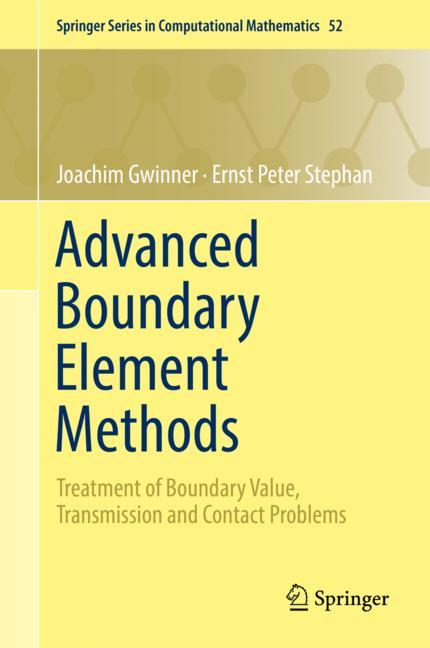
Advanced Boundary Element Methods
☆☆☆☆☆
(0 reviews)
Lowest price (incl. delivery)
10 320,00 JPY
Typical price2 629,63 PLN
Lowest (90 days)63,99 PLN
Offers3
Last updated1 hafta önce
Price history (90 days)
Full history
2026-08-08
2026-08-15
| Güncellenme Tarihi | Fiyat |
|---|---|
| 2026-08-08 | 63,99 |
| 2026-08-15 | 63,99 |
| Satıcı | Product price | Delivery | Toplam | Stok Durumu | Updated | |
|---|---|---|---|---|---|---|
| SP SpringerNatureLink Shop INT | 10 295,00 JPY | 25,00 JPY | 10 320,00 JPY | Mevcut | 5 gün önce | View offer |
| SP Springer Nature Author | 10 295,00 JPY | free | 10 295,00 JPY | Mevcut | 1 hafta önce | View offer |
| SP SpringerNatureLink Shop INT | 85,00 EUR | 29,00 EUR | 114,00 EUR | Mevcut | 5 gün önce | View offer |
Fiyatlar ve stok durumu değişebilir. Son Güncelleme: 08.08.2026 23:19.
EAN
9783319920016
Springer Nature
0,0
☆☆☆☆☆
0 reviews
5★
0%
4★
0%
3★
0%
2★
0%
1★
0%
Product reviews
No reviews yet — be the first!
This book is devoted to the mathematical analysis of the numerical solution of boundary integral equations treating boundary value, transmission and contact problems arising in elasticity, acoustic and electromagnetic scattering. It serves as the mathematical foundation of the boundary element methods (BEM) both for static and dynamic problems. The book presents a systematic approach to the variational methods for boundary integral equations including the treatment with variational inequalities for contact problems. It also features adaptive BEM, hp-version BEM, coupling of finite and boundary element methods – efficient computational tools that have become extremely popular in applications. Familiarizing readers with tools like Mellin transformation and pseudodifferential operators as well as convex and nonsmooth analysis for variational inequalities, it concisely presents efficient, state-of-the-art boundary element approximations and points to up-to-date research. The authors are well known for their fundamental work on boundary elements and related topics, and this book is a major contribution to the modern theory of the BEM (especially for error controlled adaptive methods and for unilateral contact and dynamic problems) and is a valuable resource for applied mathematicians, engineers, scientists and graduate students.
Similar products
 50 Years of Philosophy and Medicine
from $107.30
50 Years of Philosophy and Medicine
from $107.30
 Understanding Cybersecurity Law and Digital Privacy
from $122.63
Understanding Cybersecurity Law and Digital Privacy
from $122.63
 Decisions in International Trade and Logistics
from $122.63
Decisions in International Trade and Logistics
from $122.63
 Advances in Economic Measurement
from $122.63
Advances in Economic Measurement
from $122.63
 Nanomaterials
from $137.96
Nanomaterials
from $137.96
 Sustainable Scaffolds-based Strategies in Tissue Engineering and Regenerative Medicine
from $162.87
Sustainable Scaffolds-based Strategies in Tissue Engineering and Regenerative Medicine
from $162.87
 Narratives in Educational Research
from $162.87
Narratives in Educational Research
from $162.87
 Environmental Biology of the Young Chinese Sturgeon
from $210.78
Environmental Biology of the Young Chinese Sturgeon
from $210.78