
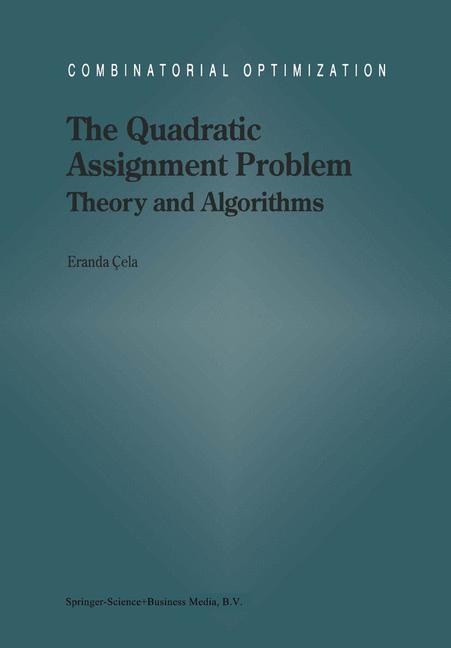
The Quadratic Assignment Problem
☆☆☆☆☆
(0 reviews)
Lowest price (incl. delivery)
21 449,00 JPY
Typical price3 320,74 PLN
Lowest (90 days)129,99 PLN
Offers6
Last updated1 สัปดาห์ที่แล้ว
Price history (90 days)
Full history
2026-08-08
2026-08-15
| อัปเดตเมื่อ | ราคา |
|---|---|
| 2026-08-08 | 129,99 |
| 2026-08-15 | 155,99 |
| ผู้ขาย | Product price | Delivery | รวม | ความพร้อมจำหน่าย | Updated | |
|---|---|---|---|---|---|---|
| SP SpringerNatureLink Shop INT | 21 449,00 JPY | free | 21 449,00 JPY | มีจำหน่าย | 3 วันที่แล้ว | View offer |
| SP Springer Nature Author | 21 449,00 JPY | 19,00 JPY | 21 468,00 JPY | มีจำหน่าย | 1 สัปดาห์ที่แล้ว | View offer |
| SP SpringerNatureLink Shop INT | 149,99 USD | 25,00 USD | 174,99 USD | มีจำหน่าย | 3 วันที่แล้ว | View offer |
| SP SpringerNatureLink Shop INT | 169,99 USD | 25,00 USD | 194,99 USD | มีจำหน่าย | 3 วันที่แล้ว | View offer |
| SP SpringerNatureLink Shop INT | 169,99 USD | 15,00 USD | 184,99 USD | มีจำหน่าย | 3 วันที่แล้ว | View offer |
| SP SpringerNatureLink Shop INT | 177,00 EUR | 25,00 EUR | 202,00 EUR | มีจำหน่าย | 3 วันที่แล้ว | View offer |
ราคาและความพร้อมจำหน่ายอาจมีการเปลี่ยนแปลง อัปเดตล่าสุด: 08.08.2026 23:33.
0,0
☆☆☆☆☆
0 reviews
5★
0%
4★
0%
3★
0%
2★
0%
1★
0%
Product reviews
No reviews yet — be the first!
The quadratic assignment problem (QAP) was introduced in 1957 by Koopmans and Beckmann to model a plant location problem. Since then the QAP has been object of numerous investigations by mathematicians, computers scientists, ope- tions researchers and practitioners. Nowadays the QAP is widely considered as a classical combinatorial optimization problem which is (still) attractive from many points of view. In our opinion there are at last three main reasons which make the QAP a popular problem in combinatorial optimization. First, the number of re- life problems which are mathematically modeled by QAPs has been continuously increasing and the variety of the fields they belong to is astonishing. To recall just a restricted number among the applications of the QAP let us mention placement problems, scheduling, manufacturing, VLSI design, statistical data analysis, and parallel and distributed computing. Secondly, a number of other well known c- binatorial optimization problems can be formulated as QAPs. Typical examples are the traveling salesman problem and a large number of optimization problems in graphs such as the maximum clique problem, the graph partitioning problem and the minimum feedback arc set problem. Finally, from a computational point of view the QAP is a very difficult problem. The QAP is not only NP-hard and - hard to approximate, but it is also practically intractable: it is generally considered as impossible to solve (to optimality) QAP instances of size larger than 20 within reasonable time limits.
Similar products
 50 Years of Philosophy and Medicine
from $107.30
50 Years of Philosophy and Medicine
from $107.30
 Understanding Cybersecurity Law and Digital Privacy
from $122.63
Understanding Cybersecurity Law and Digital Privacy
from $122.63
 Decisions in International Trade and Logistics
from $122.63
Decisions in International Trade and Logistics
from $122.63
 Advances in Economic Measurement
from $122.63
Advances in Economic Measurement
from $122.63
 Nanomaterials
from $137.96
Nanomaterials
from $137.96
 Sustainable Scaffolds-based Strategies in Tissue Engineering and Regenerative Medicine
from $162.87
Sustainable Scaffolds-based Strategies in Tissue Engineering and Regenerative Medicine
from $162.87
 Narratives in Educational Research
from $162.87
Narratives in Educational Research
from $162.87
 Environmental Biology of the Young Chinese Sturgeon
from $210.78
Environmental Biology of the Young Chinese Sturgeon
from $210.78