
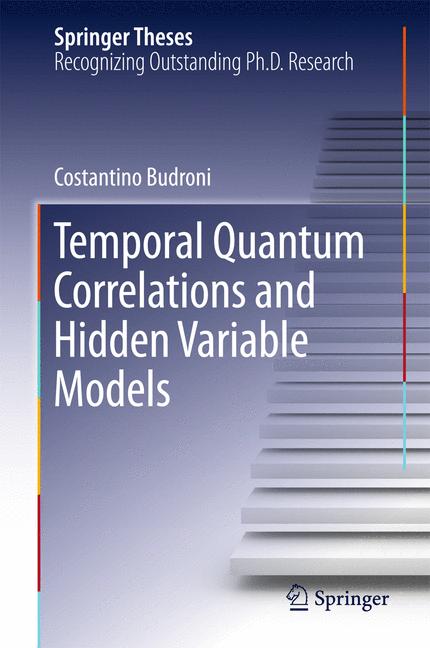
Temporal Quantum Correlations and Hidden Variable Models
☆☆☆☆☆
(0 reviews)
Lowest price (incl. delivery)
14 314,00 JPY
Typical price1 121,45 PLN
Lowest (90 days)71,50 PLN
Offers6
Last updated1 สัปดาห์ที่แล้ว
Price history (90 days)
Full history
2026-08-08
2026-08-15
| อัปเดตเมื่อ | ราคา |
|---|---|
| 2026-08-08 | 84,99 |
| 2026-08-15 | 71,50 |
| ผู้ขาย | Product price | Delivery | รวม | ความพร้อมจำหน่าย | Updated | |
|---|---|---|---|---|---|---|
| SP SpringerNatureLink Shop INT | 14 299,00 JPY | 15,00 JPY | 14 314,00 JPY | มีจำหน่าย | 5 วันที่แล้ว | View offer |
| SP Springer Nature Author | 14 299,00 JPY | 15,00 JPY | 14 314,00 JPY | มีจำหน่าย | 1 สัปดาห์ที่แล้ว | View offer |
| SP SpringerNatureLink Shop INT | 99,99 USD | free | 99,99 USD | มีจำหน่าย | 5 วันที่แล้ว | View offer |
| SP SpringerNatureLink Shop INT | 109,99 USD | free | 109,99 USD | มีจำหน่าย | 5 วันที่แล้ว | View offer |
| SP SpringerNatureLink Shop INT | 109,99 USD | 29,00 USD | 138,99 USD | มีจำหน่าย | 5 วันที่แล้ว | View offer |
| SP SpringerNatureLink Shop INT | 118,00 EUR | 19,00 EUR | 137,00 EUR | มีจำหน่าย | 5 วันที่แล้ว | View offer |
ราคาและความพร้อมจำหน่ายอาจมีการเปลี่ยนแปลง อัปเดตล่าสุด: 08.08.2026 23:20.
0,0
☆☆☆☆☆
0 reviews
5★
0%
4★
0%
3★
0%
2★
0%
1★
0%
Product reviews
No reviews yet — be the first!
In this thesis, the main approach to the characterization of the set of classical probabilities, the correlation polytope approach, is reviewed for different scenarios, namely, hidden variable models discussed by Bell (local), Kochen and Specker (non-contextual), and Leggett and Garg (macrorealist). Computational difficulties associated with the method are described and a method to overcome them in several nontrivial cases is presented. For the quantum case, a general method to analyze quantum correlations in the sequential measurement scenario is provided, which allows computation of the maximal correlations. Such a method has a direct application for computation of maximal quantum violations of Leggett-Garg inequalities and it is relevant in the analysis of non-contextuality tests. Finally, possible applications of the results for quantum information tasks are discussed.
Similar products
 50 Years of Philosophy and Medicine
from $107.30
50 Years of Philosophy and Medicine
from $107.30
 Understanding Cybersecurity Law and Digital Privacy
from $122.63
Understanding Cybersecurity Law and Digital Privacy
from $122.63
 Decisions in International Trade and Logistics
from $122.63
Decisions in International Trade and Logistics
from $122.63
 Advances in Economic Measurement
from $122.63
Advances in Economic Measurement
from $122.63
 Nanomaterials
from $137.96
Nanomaterials
from $137.96
 Sustainable Scaffolds-based Strategies in Tissue Engineering and Regenerative Medicine
from $162.87
Sustainable Scaffolds-based Strategies in Tissue Engineering and Regenerative Medicine
from $162.87
 Narratives in Educational Research
from $162.87
Narratives in Educational Research
from $162.87
 Environmental Biology of the Young Chinese Sturgeon
from $210.78
Environmental Biology of the Young Chinese Sturgeon
from $210.78