
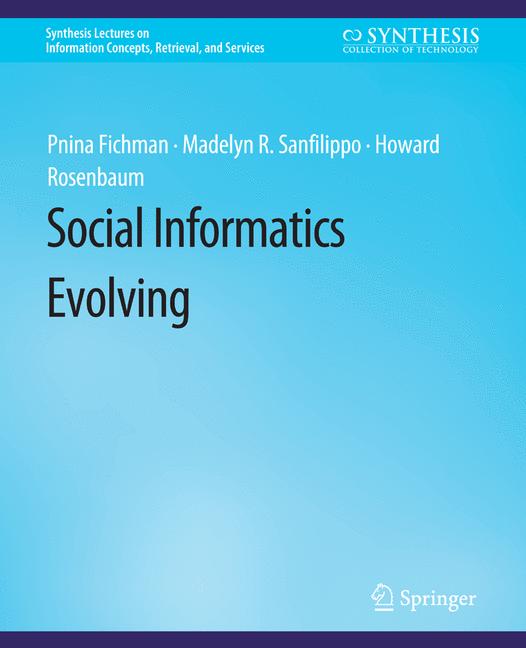
Social Informatics Evolving
☆☆☆☆☆
(0 reviews)
Lowest price (incl. delivery)
42,30 EUR
Typical price270,75 PLN
Lowest (90 days)14,54 PLN
Offers4
Last updated1 สัปดาห์ที่แล้ว
Price history (90 days)
Full history
2026-08-07
2026-08-14
| อัปเดตเมื่อ | ราคา |
|---|---|
| 2026-08-07 | 14,54 |
| 2026-08-08 | 24,71 |
| 2026-08-14 | 24,71 |
| ผู้ขาย | Product price | Delivery | รวม | ความพร้อมจำหน่าย | Updated | |
|---|---|---|---|---|---|---|
| SP SpringerNatureLink Shop INT | 27,30 EUR | 15,00 EUR | 42,30 EUR | มีจำหน่าย | 2 วันที่แล้ว | View offer |
| SP SpringerNatureLink Shop INT | 4 718,00 JPY | 29,00 JPY | 4 747,00 JPY | มีจำหน่าย | 1 วันที่แล้ว | View offer |
| SP Springer Nature Author | 4 718,00 JPY | 25,00 JPY | 4 743,00 JPY | มีจำหน่าย | 1 สัปดาห์ที่แล้ว | View offer |
| VI VitalSource | 199,24 ZAR | 19,00 ZAR | 218,24 ZAR | มีจำหน่าย | 1 สัปดาห์ที่แล้ว | View offer |
ราคาและความพร้อมจำหน่ายอาจมีการเปลี่ยนแปลง อัปเดตล่าสุด: 08.08.2026 05:21.
EAN
9783031011696
Springer Nature
0,0
☆☆☆☆☆
0 reviews
5★
0%
4★
0%
3★
0%
2★
0%
1★
0%
Product reviews
No reviews yet — be the first!
The study of people, information, and communication technologies and the contexts in which these technologies are designed, implemented, and used has long interested scholars in a wide range of disciplines, including the social study of computing, science and technology studies, the sociology of technology, and management information systems. As ICT use has spread from organizations into the larger world, these devices have become routine information appliances in our social lives, researchers have begun to ask deeper and more profound questions about how our lives have become bound up with technologies. A common theme running through this research is that the relationships among people, technology, and context are dynamic, complex, and critically important to understand. This book explores social informatics (SI), one important and dynamic approach that researchers have used to study these complex relationships. SI is "the interdisciplinary study of the design, uses and consequences of information technology that takes into account their interaction with institutional and cultural contexts" (Kling 1998, p. 52; 1999). SI provides flexible frameworks to explore complex and dynamic socio-technical interactions. As a domain of study related largely by common vocabulary and conclusions, SI critically examines common conceptions of and expectations for technology, by providing contextual evidence. This book describes the evolution of SI research and identifies challenges and opportunities for future research. In what might be seen as an example of socio-technical "natural selection," SI emerged in six different locations during the 1980s and 1990s: Norway, Slovenia, Japan, the former Soviet Union, the UK and, last, the U.S. As SI evolved, the version popularized in the US became globally dominant. The evolution of SI is presented in five stages: emergence, foundational, expansion, coherence, and transformation. Thus, we divide SI research into five major periods: an emergence stage, when various forms of SI emerged around the globe, an early period of foundational work which grounds SI (Pre-1990s), a period of expansion (1990s), a robust period of coherence and influence by Rob Kling (2000–2005), and a period of transformation (2006–present). Following the description of the five periods we discuss the evolution throughout the periods under five sections: principles, concepts, approaches, topics, and findings. Principles refer to the overarching motivations and labels employed to describe scholarly work. Approaches describe the theories, frameworks, and models employed in analysis, emphasizing the multi-disciplinary and interdisciplinary nature of SI. Concepts include specific processes, entities, themes, and elements of discourse within a given context, revealing a shared SI language surrounding change, complexity, consequences, and social elements of technology. Topics label the issues and general domains studied within social informatics, ranging from scholarly communication to online communities to information systems. Findings from seminal SI works illustrate growing insights over time and demonstrate how repeatable explanations unify SI. In the concluding remarks, we raise questions about the possible futures of SI research.
Similar products
 50 Years of Philosophy and Medicine
from $107.30
50 Years of Philosophy and Medicine
from $107.30
 Understanding Cybersecurity Law and Digital Privacy
from $122.63
Understanding Cybersecurity Law and Digital Privacy
from $122.63
 Decisions in International Trade and Logistics
from $122.63
Decisions in International Trade and Logistics
from $122.63
 Advances in Economic Measurement
from $122.63
Advances in Economic Measurement
from $122.63
 Nanomaterials
from $137.96
Nanomaterials
from $137.96
 Sustainable Scaffolds-based Strategies in Tissue Engineering and Regenerative Medicine
from $162.87
Sustainable Scaffolds-based Strategies in Tissue Engineering and Regenerative Medicine
from $162.87
 Narratives in Educational Research
from $162.87
Narratives in Educational Research
from $162.87
 Environmental Biology of the Young Chinese Sturgeon
from $210.78
Environmental Biology of the Young Chinese Sturgeon
from $210.78