
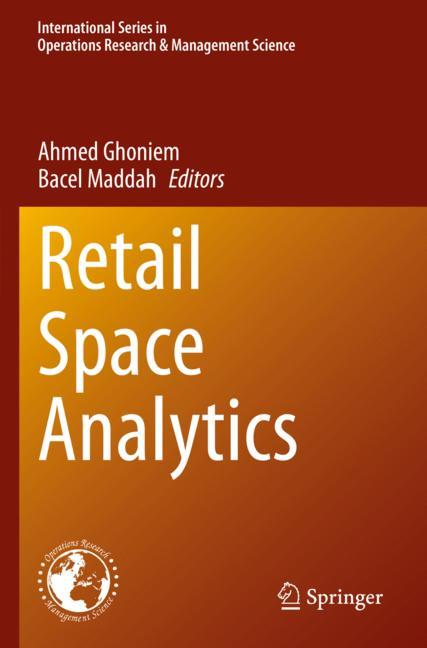
Retail Space Analytics
☆☆☆☆☆
(0 reviews)
Lowest price (incl. delivery)
140,70 EUR
Typical price12 232,57 PLN
Lowest (90 days)140,70 PLN
Offers3
Last updated1 สัปดาห์ที่แล้ว
| ผู้ขาย | Product price | Delivery | รวม | ความพร้อมจำหน่าย | Updated | |
|---|---|---|---|---|---|---|
| SP SpringerNatureLink Shop INT | 140,70 EUR | free | 140,70 EUR | มีจำหน่าย | 5 วันที่แล้ว | View offer |
| SP SpringerNatureLink Shop INT | 24 309,00 JPY | free | 24 309,00 JPY | มีจำหน่าย | 5 วันที่แล้ว | View offer |
| SP Springer Nature Author | 24 309,00 JPY | 15,00 JPY | 24 324,00 JPY | มีจำหน่าย | 1 สัปดาห์ที่แล้ว | View offer |
ราคาและความพร้อมจำหน่ายอาจมีการเปลี่ยนแปลง อัปเดตล่าสุด: 08.08.2026 22:44.
EAN
9783031270604
Springer Nature
0,0
☆☆☆☆☆
0 reviews
5★
0%
4★
0%
3★
0%
2★
0%
1★
0%
Product reviews
No reviews yet — be the first!
This edited volume presents state-of-the-art research that can leverage large-scale sensory data collected in grocery/retail stores where a single customer visit may generate nearly 10,000 data points. For decades, retail shelf space optimization has been confined to the analysis of product allocation decisions over a limited number of shelves, often taken in isolation. Such models incorporated interesting concepts relating to space and cross-space elasticity in the design of planograms. Although useful, these models have not addressed the bigger picture of planning store shelf space in a more holistic manner. It is important to note that the space planning analytics in the book are particularly important in an era where e-commerce is on the rise and brick-and-mortar retailing is declining and experiencing severe crises (the retail apocalypse). This is the first research-oriented book that examines novel problems in store space analytics, triggered by modern-day sensorytechnologies, customer trackers, and transactional tools (point-of-sales, etc.). In fact, such transformative technologies have prompted the development of new and exciting business practices, accompanied by the need for powerful data-driven models and analyses in retail shelf space and layout planning. The book will facilitate developing algorithms and decision tools that allow a better leverage of the data collected from these mediums.
Similar products
 50 Years of Philosophy and Medicine
from $107.30
50 Years of Philosophy and Medicine
from $107.30
 Understanding Cybersecurity Law and Digital Privacy
from $122.63
Understanding Cybersecurity Law and Digital Privacy
from $122.63
 Decisions in International Trade and Logistics
from $122.63
Decisions in International Trade and Logistics
from $122.63
 Advances in Economic Measurement
from $122.63
Advances in Economic Measurement
from $122.63
 Nanomaterials
from $137.96
Nanomaterials
from $137.96
 Sustainable Scaffolds-based Strategies in Tissue Engineering and Regenerative Medicine
from $162.87
Sustainable Scaffolds-based Strategies in Tissue Engineering and Regenerative Medicine
from $162.87
 Narratives in Educational Research
from $162.87
Narratives in Educational Research
from $162.87
 Environmental Biology of the Young Chinese Sturgeon
from $210.78
Environmental Biology of the Young Chinese Sturgeon
from $210.78