
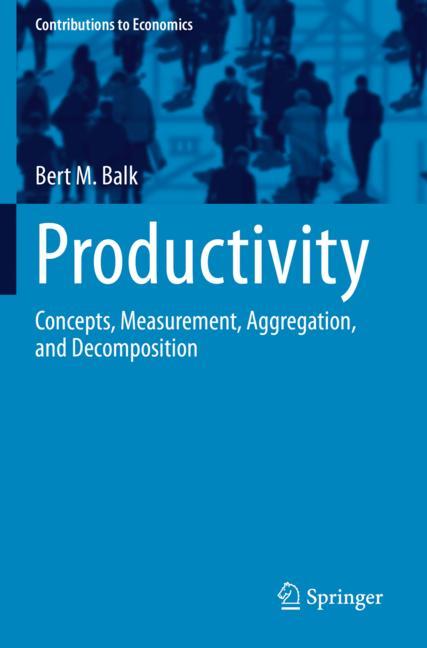
Productivity
☆☆☆☆☆
(0 reviews)
Lowest price (incl. delivery)
29,00 USD
Typical price1 108,15 PLN
Lowest (90 days)87,50 PLN
Offers7
Last updated1 สัปดาห์ที่แล้ว
Price history (90 days)
Full history
2026-08-08
2026-08-15
| อัปเดตเมื่อ | ราคา |
|---|---|
| 2026-08-08 | 87,50 |
| 2026-08-15 | 87,50 |
| ผู้ขาย | Product price | Delivery | รวม | ความพร้อมจำหน่าย | Updated | |
|---|---|---|---|---|---|---|
| KN Knetbooks.com | 10,00 USD | 19,00 USD | 29,00 USD | มีจำหน่าย | 1 สัปดาห์ที่แล้ว | View offer |
| SP SpringerNatureLink Shop INT | 17 159,00 JPY | free | 17 159,00 JPY | มีจำหน่าย | 1 สัปดาห์ที่แล้ว | View offer |
| SP Springer Nature Author | 17 159,00 JPY | 29,00 JPY | 17 188,00 JPY | มีจำหน่าย | 1 สัปดาห์ที่แล้ว | View offer |
| SP SpringerNatureLink Shop INT | 119,99 USD | 29,00 USD | 148,99 USD | มีจำหน่าย | 1 สัปดาห์ที่แล้ว | View offer |
| SP SpringerNatureLink Shop INT | 129,99 USD | 15,00 USD | 144,99 USD | มีจำหน่าย | 1 สัปดาห์ที่แล้ว | View offer |
| SP SpringerNatureLink Shop INT | 129,99 USD | 19,00 USD | 148,99 USD | มีจำหน่าย | 1 สัปดาห์ที่แล้ว | View offer |
| SP SpringerNatureLink Shop INT | 142,00 EUR | 19,00 EUR | 161,00 EUR | มีจำหน่าย | 1 สัปดาห์ที่แล้ว | View offer |
ราคาและความพร้อมจำหน่ายอาจมีการเปลี่ยนแปลง อัปเดตล่าสุด: 09.08.2026 05:15.
0,0
☆☆☆☆☆
0 reviews
5★
0%
4★
0%
3★
0%
2★
0%
1★
0%
Product reviews
No reviews yet — be the first!
This book develops the theory of productivity measurement using the empirical index number approach. The theory uses multiplicative indices and additive indicators as measurement tools, instead of relying on the usual neo-classical assumptions, such as the existence of a production function characterized by constant returns to scale, optimizing behavior of the economic agents, and perfect foresight. The theory can be applied to all the common levels of aggregation (micro, meso, and macro), and half of the book is devoted to accounting for the links existing between the various levels. Basic insights from National Accounts are thereby used. The final chapter is devoted to the decomposition of productivity change into the contributions of efficiency change, technological change, scale effects, and input or output mix effects. Applications on real-life data demonstrate the empirical feasibility of the theory. The book is directed to a variety of overlapping audiences: statisticians involved in measuring productivity change; economists interested in growth accounting; researchers relating macro-economic productivity change to its industrial sources; enterprise micro-data researchers; and business analysts interested in performance measurement.
Similar products
 Sustainable Development
from $2,281.25
Sustainable Development
from $2,281.25
 Author Title and Subject Guide
from $1,780.26
Author Title and Subject Guide
from $1,780.26
 Debating Issues in American Education
from $825.02
Debating Issues in American Education
from $825.02
 Karl Popper
from $1,978.07
Karl Popper
from $1,978.07
 Encyclopedia of Journalism
from $1,058.62
Encyclopedia of Journalism
from $1,058.62
 NUR 110 Print+Ebook Bundle
from $1,908.35
NUR 110 Print+Ebook Bundle
from $1,908.35
 GMR Springfield Paramedic 9E Flipped Bundle Updated .
from $1,382.58
Nursing Volume 1 & 2 with Clinical Nursing Skills Volume 3 & MyNursingLab Package
from $1,183.17
GMR Springfield Paramedic 9E Flipped Bundle Updated .
from $1,382.58
Nursing Volume 1 & 2 with Clinical Nursing Skills Volume 3 & MyNursingLab Package
from $1,183.17