
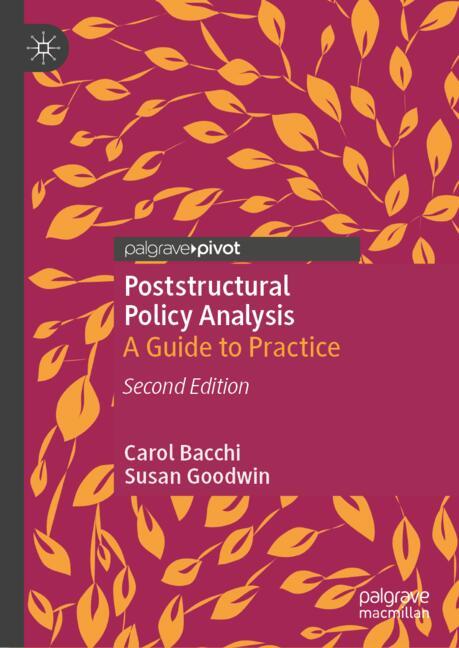
Poststructural Policy Analysis
☆☆☆☆☆
(0 reviews)
Lowest price (incl. delivery)
72,50 EUR
Typical price44,75 PLN
Lowest (90 days)41,59 PLN
Offers2
Last updated1 สัปดาห์ที่แล้ว
Price history (90 days)
Full history
2026-08-08
2026-08-14
| อัปเดตเมื่อ | ราคา |
|---|---|
| 2026-08-08 | 41,59 |
| 2026-08-14 | 41,59 |
| ผู้ขาย | Product price | Delivery | รวม | ความพร้อมจำหน่าย | Updated | |
|---|---|---|---|---|---|---|
| SP SpringerNatureLink Shop INT | 47,50 EUR | 25,00 EUR | 72,50 EUR | มีจำหน่าย | 4 วันที่แล้ว | View offer |
| SP Springer Nature Author | 47,50 EUR | 15,00 EUR | 62,50 EUR | มีจำหน่าย | 1 สัปดาห์ที่แล้ว | View offer |
ราคาและความพร้อมจำหน่ายอาจมีการเปลี่ยนแปลง อัปเดตล่าสุด: 08.08.2026 09:13.
EAN
9781349961337
Springer Nature
0,0
☆☆☆☆☆
0 reviews
5★
0%
4★
0%
3★
0%
2★
0%
1★
0%
Product reviews
No reviews yet — be the first!
This book offers a distinctive approach to policy analysis and a refreshing and politically engaged way of thinking about policy. It clearly articulates a Foucault-influenced poststructural perspective on policy and policy analysis for researchers, students and policy makers. As a "guide to practice", the book introduces a critical analytical approach to policy analysis called ‘What’s the Problem Represented to be?’ (WPR). Instead of treating policy as simply the government’s best efforts to address problems, this analytic strategy highlights how policies produce ‘problems’ as particular sorts of problem and how governing takes place through these problematisations. First published in 2016, the book describes the conceptual and theoretical underpinnings of the WPR approach to policy analysis in a detailed and accessible manner. It features examples of application of the approach with topics as diverse as obesity, economic policy, migration, drug and alcohol policy, and gender equality. In this second edition, the authors centralise a complementary analytic strategy for poststructural policy analysis—poststructural interview analysis (PIA). This edition integrates this material as a new chapter which sets out PIA as a novel approach to poststructural interview analysis and includes examples of PIA applications. The new chapter provides excellent guidance to undertake interview analysis in a manner congruent with the poststructural precepts set out in the book.
Similar products
 50 Years of Philosophy and Medicine
from $107.30
50 Years of Philosophy and Medicine
from $107.30
 Understanding Cybersecurity Law and Digital Privacy
from $122.63
Understanding Cybersecurity Law and Digital Privacy
from $122.63
 Decisions in International Trade and Logistics
from $122.63
Decisions in International Trade and Logistics
from $122.63
 Advances in Economic Measurement
from $122.63
Advances in Economic Measurement
from $122.63
 Nanomaterials
from $137.96
Nanomaterials
from $137.96
 Sustainable Scaffolds-based Strategies in Tissue Engineering and Regenerative Medicine
from $162.87
Sustainable Scaffolds-based Strategies in Tissue Engineering and Regenerative Medicine
from $162.87
 Narratives in Educational Research
from $162.87
Narratives in Educational Research
from $162.87
 Environmental Biology of the Young Chinese Sturgeon
from $210.78
Environmental Biology of the Young Chinese Sturgeon
from $210.78