
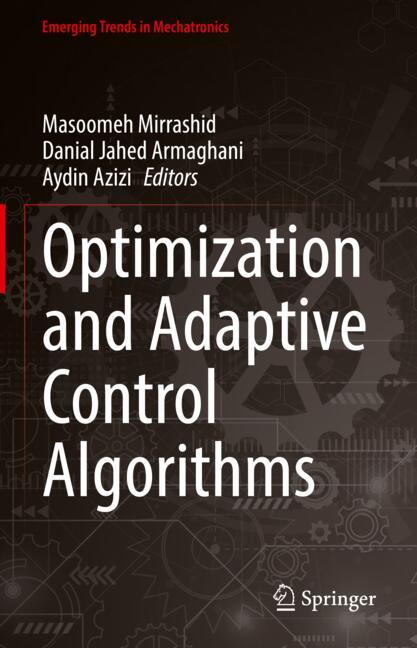
Optimization and Adaptive Control Algorithms
☆☆☆☆☆
(0 reviews)
Lowest price (incl. delivery)
194,99 USD
Typical price179,94 PLN
Lowest (90 days)149,99 PLN
Offers5
Last updated4 ชั่วโมงที่แล้ว
| ผู้ขาย | Product price | Delivery | รวม | ความพร้อมจำหน่าย | Updated | |
|---|---|---|---|---|---|---|
| SP SpringerNatureLink Shop INT | 169,99 USD | 25,00 USD | 194,99 USD | มีจำหน่าย | 4 ชั่วโมงที่แล้ว | View offer |
| SP SpringerNatureLink Shop INT | 169,99 USD | free | 169,99 USD | มีจำหน่าย | 4 ชั่วโมงที่แล้ว | View offer |
| SP SpringerNatureLink Shop INT | 199,99 USD | 19,00 USD | 218,99 USD | มีจำหน่าย | 4 ชั่วโมงที่แล้ว | View offer |
| SP SpringerNatureLink Shop INT | 199,99 USD | 25,00 USD | 224,99 USD | มีจำหน่าย | 4 ชั่วโมงที่แล้ว | View offer |
| SP SpringerNatureLink Shop INT | 186,99 EUR | 15,00 EUR | 201,99 EUR | มีจำหน่าย | 4 ชั่วโมงที่แล้ว | View offer |
ราคาและความพร้อมจำหน่ายอาจมีการเปลี่ยนแปลง อัปเดตล่าสุด: 15.08.2026 06:38.
0,0
☆☆☆☆☆
0 reviews
5★
0%
4★
0%
3★
0%
2★
0%
1★
0%
Product reviews
No reviews yet — be the first!
This book presents smart optimization techniques and adaptive intelligent control systems which stimulate innovations in engineering and computational science. This book captures these innovations and describes multiple applications of various advanced algorithms. The book encompasses a diverse range of applications and illustrates the value of these computational techniques; notable applications include the attitude control of CubeSats, the performance of building components during seismic events, the efficiency of tunnel-boring machines, and forecasting of environmental and structural phenomena. A major theme presented within the book is the development of advanced intelligent systems, including self-optimizing modules, as reflected in research advances on Digital Twins and Omniverse technologies, where real-time supervision and control are achieved through virtual replicas of physical entities and spatial environments. The incorporation of artificial intelligence (AI) provides essential simplifications of otherwise opaque models, yielding interpretable insights that facilitate process automation. By connecting rigorous theoretical work with real-world problems, the book serves as a guide for researchers, engineers, and students, which offers a comprehensive picture of advanced developments in the area of adaptive optimized systems, alongside the theory and practice necessary to innovate within systems engineering.
Similar products
 50 Years of Philosophy and Medicine
from $107.30
50 Years of Philosophy and Medicine
from $107.30
 Understanding Cybersecurity Law and Digital Privacy
from $122.63
Understanding Cybersecurity Law and Digital Privacy
from $122.63
 Decisions in International Trade and Logistics
from $122.63
Decisions in International Trade and Logistics
from $122.63
 Advances in Economic Measurement
from $122.63
Advances in Economic Measurement
from $122.63
 Nanomaterials
from $137.96
Nanomaterials
from $137.96
 Sustainable Scaffolds-based Strategies in Tissue Engineering and Regenerative Medicine
from $162.87
Sustainable Scaffolds-based Strategies in Tissue Engineering and Regenerative Medicine
from $162.87
 Narratives in Educational Research
from $162.87
Narratives in Educational Research
from $162.87
 Environmental Biology of the Young Chinese Sturgeon
from $210.78
Environmental Biology of the Young Chinese Sturgeon
from $210.78