
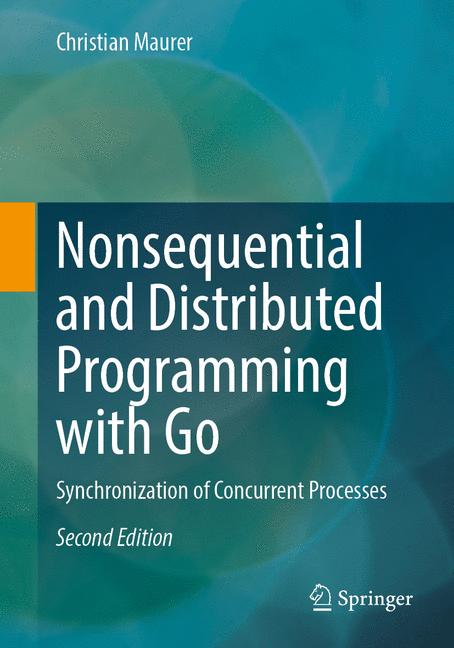
Nonsequential and Distributed Programming with Go
☆☆☆☆☆
(0 reviews)
Lowest price (incl. delivery)
68,05 EUR
Typical price43,05 PLN
Lowest (90 days)43,05 PLN
Offers3
Last updated3 วันที่แล้ว
| ผู้ขาย | Product price | Delivery | รวม | ความพร้อมจำหน่าย | Updated | |
|---|---|---|---|---|---|---|
| SP SpringerNatureLink Shop INT | 43,05 EUR | 25,00 EUR | 68,05 EUR | มีจำหน่าย | 4 วันที่แล้ว | View offer |
| SP Springer Nature Author | 43,05 EUR | free | 43,05 EUR | มีจำหน่าย | 1 สัปดาห์ที่แล้ว | View offer |
| SP SpringerNatureLink Shop INT | 7 435,00 JPY | free | 7 435,00 JPY | มีจำหน่าย | 3 วันที่แล้ว | View offer |
ราคาและความพร้อมจำหน่ายอาจมีการเปลี่ยนแปลง อัปเดตล่าสุด: 15.08.2026 07:52.
EAN
9783662709290
Springer Nature
0,0
☆☆☆☆☆
0 reviews
5★
0%
4★
0%
3★
0%
2★
0%
1★
0%
Product reviews
No reviews yet — be the first!
After a short chapter on basic aspects of software engineering and its realization in Go, this book introduces to nonsequential and distributed programming with Go. It systematically presents basic concepts for the synchronization and communication of concurrent processes. These include locks, semaphores, fairness and deadlocks, monitors, local and network-wide message passing, networks as graphs, network exploration, distributed depth and breadth first search, and the selection of a leader in networks. In order to make readers familiar with the concepts, the author always takes up the same classic examples. This makes learning easier, because the concepts presented can be compared more easily with the language resources. The algorithms are formulated in the Go programming language, which can be used to express numerous synchronization concepts. Due to its simple syntax, Go also offers the advantage that readers without prior knowledge can follow the basic concepts. The chapters on locks, semaphores, monitors and network-wide message passing also present some basic approaches to programming in C and Java. All source texts are available online. Besides a number of error corrections and smaller updates, in this second edition the nanouniverse nU is replaced with the microuniverse μU. This allows for beautiful animations in many places, which are not possible with the nanouniverse due to a lack of the necessary support for inputs and outputs; e.g. in the chapters on fairness, messages, farMonitors, traversals and election.
Similar products
 50 Years of Philosophy and Medicine
from $107.30
50 Years of Philosophy and Medicine
from $107.30
 Understanding Cybersecurity Law and Digital Privacy
from $122.63
Understanding Cybersecurity Law and Digital Privacy
from $122.63
 Decisions in International Trade and Logistics
from $122.63
Decisions in International Trade and Logistics
from $122.63
 Advances in Economic Measurement
from $122.63
Advances in Economic Measurement
from $122.63
 Nanomaterials
from $137.96
Nanomaterials
from $137.96
 Sustainable Scaffolds-based Strategies in Tissue Engineering and Regenerative Medicine
from $162.87
Sustainable Scaffolds-based Strategies in Tissue Engineering and Regenerative Medicine
from $162.87
 Narratives in Educational Research
from $162.87
Narratives in Educational Research
from $162.87
 Environmental Biology of the Young Chinese Sturgeon
from $210.78
Environmental Biology of the Young Chinese Sturgeon
from $210.78