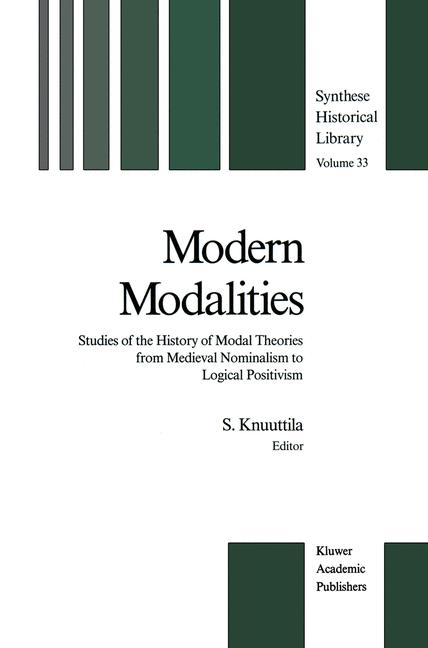
Modern Modalities
☆☆☆☆☆
(0 reviews)
EAN: 9789401078122
Lowest price (incl. delivery)
40 054,00 JPY
- Offers
- 2
- Last updated
- 3 เดือนที่แล้ว
| ผู้ขาย | Product price | Delivery | รวม | ความพร้อมจำหน่าย | Updated | |
|---|---|---|---|---|---|---|
| Springer Nature Author | Product price 40 039,00 JPY ▲ 12 014,7% | Delivery 15,00 JPY | รวม 40 054,00 JPY | ความพร้อมจำหน่าย มีจำหน่าย | Updated 3 เดือนที่แล้ว | View offer |
| SpringerNatureLink Shop INT | Product price 330,50 EUR ▲ 7,3% | Delivery 25,00 EUR | รวม 355,50 EUR | ความพร้อมจำหน่าย มีจำหน่าย | Updated 3 เดือนที่แล้ว | View offer |
ราคาและความพร้อมจำหน่ายอาจมีการเปลี่ยนแปลง อัปเดตล่าสุด: 08.08.2026 23:40.
EAN
9789401078122
Springer Nature
0,0
☆☆☆☆☆
0 reviews
5★
0%
4★
0%
3★
0%
2★
0%
1★
0%
Product reviews
No reviews yet — be the first!
The word "modem" in the title of this book refers primarily to post-medieval discussions, but it also hints at those medieval mo dal theories which were considered modem in contradistinction to ancient conceptions and which in different ways influenced philosophical discussions during the early modem period. The me dieval developments are investigated in the opening paper, 'The Foundations of Modality and Conceivability in Descartes and His Predecessors', by Lilli Alanen and Simo Knuuttila. Boethius's works from the early sixth century belonged to the sources from which early medieval thinkers obtained their knowledge of ancient thought. They offered extensive discus sions of traditional modal conceptions the basic forms of which were: (1) the paradigm of possibility as a potency striving to realize itself; (2) the "statistical" interpretation of modal no tions where necessity means actuality in all relevant cases or omnitemporal actuality, possibility means actuality in some rel evant cases or sometimes, and impossibility means omnitemporal non-actuality; and (3) the "logical" definition of possibility as something which, being assumed, results in nothing contradic tory. Boethius accepted the Aristotelian view according to which total possibilities in the first sense must prove their met tle through actualization and possibilities in the third sense are assumed to be realized in our actual history. On these presump tions, all of the above-mentioned ancient paradigms imply the Principle of Plenitude according to which no genuine possibility remains unrealized.
Similar products