
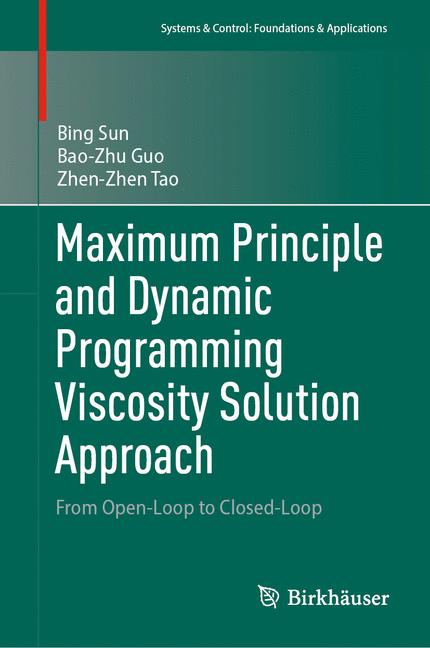
Maximum Principle and Dynamic Programming Viscosity Solution Approach
☆☆☆☆☆
(0 reviews)
Lowest price (incl. delivery)
18 328,00 JPY
Typical price3 172,34 PLN
Lowest (90 days)139,00 PLN
Offers3
Last updated6 วันที่แล้ว
Price history (90 days)
Full history
2026-08-08
2026-08-15
| อัปเดตเมื่อ | ราคา |
|---|---|
| 2026-08-08 | 139,00 |
| 2026-08-15 | 151,00 |
| ผู้ขาย | Product price | Delivery | รวม | ความพร้อมจำหน่าย | Updated | |
|---|---|---|---|---|---|---|
| SP SpringerNatureLink Shop INT | 18 303,00 JPY | 25,00 JPY | 18 328,00 JPY | มีจำหน่าย | 6 วันที่แล้ว | View offer |
| SP Springer Nature Author | 18 303,00 JPY | 25,00 JPY | 18 328,00 JPY | มีจำหน่าย | 1 สัปดาห์ที่แล้ว | View offer |
| SP SpringerNatureLink Shop INT | 151,00 EUR | 19,00 EUR | 170,00 EUR | มีจำหน่าย | 6 วันที่แล้ว | View offer |
ราคาและความพร้อมจำหน่ายอาจมีการเปลี่ยนแปลง อัปเดตล่าสุด: 15.08.2026 05:36.
EAN
9789819657391
Springer Nature
0,0
☆☆☆☆☆
0 reviews
5★
0%
4★
0%
3★
0%
2★
0%
1★
0%
Product reviews
No reviews yet — be the first!
This book is concerned with optimal control problems of dynamical systems described by partial differential equations (PDEs). The content covers the theory and numerical algorithms, starting with open-loop control and ending with closed-loop control. It includes Pontryagin’s maximum principle and the Bellman dynamic programming principle based on the notion of viscosity solution. The Bellman dynamic programming method can produce the optimal control in feedback form, making it more appealing for online implementations and robustness. The determination of the optimal feedback control law is of fundamental importance in optimal control and can be argued as the Holy Grail of control theory. The book is organized into five chapters. Chapter 1 presents necessary mathematical knowledge. Chapters 2 and 3 (Part 1) focus on the open-loop control while Chapter 4 and 5 (Part 2) focus on the closed-loop control. In this monograph, we incorporate the notion of viscosity solution of PDE with dynamic programming approach. The dynamic programming viscosity solution (DPVS) approach is then used to investigate optimal control problems. In each problem, the optimal feedback law is synthesized and numerically demonstrated. The last chapter presents multiple algorithms for the DPVS approach, including an upwind finite-difference scheme with the convergence proof. It is worth noting that the dynamic systems considered are primarily of technical or biologic origin, which is a highlight of the book. This book is systematic and self-contained. It can serve the expert as a ready reference for control theory of infinite-dimensional systems. These chapters taken together would also make a one-semester course for graduate with first courses in PDE-constrained optimal control.
Similar products
 50 Years of Philosophy and Medicine
from $107.30
50 Years of Philosophy and Medicine
from $107.30
 Understanding Cybersecurity Law and Digital Privacy
from $122.63
Understanding Cybersecurity Law and Digital Privacy
from $122.63
 Decisions in International Trade and Logistics
from $122.63
Decisions in International Trade and Logistics
from $122.63
 Advances in Economic Measurement
from $122.63
Advances in Economic Measurement
from $122.63
 Nanomaterials
from $137.96
Nanomaterials
from $137.96
 Sustainable Scaffolds-based Strategies in Tissue Engineering and Regenerative Medicine
from $162.87
Sustainable Scaffolds-based Strategies in Tissue Engineering and Regenerative Medicine
from $162.87
 Narratives in Educational Research
from $162.87
Narratives in Educational Research
from $162.87
 Environmental Biology of the Young Chinese Sturgeon
from $210.78
Environmental Biology of the Young Chinese Sturgeon
from $210.78