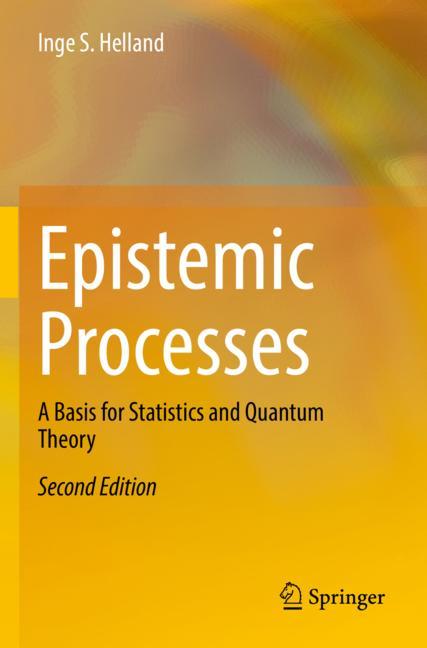
Epistemic Processes
☆☆☆☆☆
(0 reviews)
Lowest price (incl. delivery)
71,68 USD
- Offers
- 12
- Last updated
- 3 เดือนที่แล้ว
| ผู้ขาย | Product price | Delivery | รวม | ความพร้อมจำหน่าย | Updated | |
|---|---|---|---|---|---|---|
| SpringerNatureLink Shop INT | Product price 71,68 USD | Delivery free | รวม 71,68 USD | ความพร้อมจำหน่าย มีจำหน่าย | Updated 3 เดือนที่แล้ว | View offer |
| SpringerNatureLink Shop INT | Product price 71,68 USD | Delivery 15,00 USD | รวม 86,68 USD | ความพร้อมจำหน่าย มีจำหน่าย | Updated 3 เดือนที่แล้ว | View offer |
| SpringerNatureLink Shop INT | Product price 71,68 EUR ▲ 19,5% | Delivery free | รวม 71,68 EUR | ความพร้อมจำหน่าย มีจำหน่าย | Updated 3 เดือนที่แล้ว | View offer |
| …and 8 more variants from this seller (prices from 71,68 USD to 18 589,00 USD) | ||||||
| Springer Nature Author | Product price 18 589,00 JPY ▲ 12 010,1% | Delivery free | รวม 18 589,00 JPY | ความพร้อมจำหน่าย มีจำหน่าย | Updated 3 เดือนที่แล้ว | View offer |
ราคาและความพร้อมจำหน่ายอาจมีการเปลี่ยนแปลง อัปเดตล่าสุด: 08.08.2026 22:23.
0,0
☆☆☆☆☆
0 reviews
5★
0%
4★
0%
3★
0%
2★
0%
1★
0%
Product reviews
No reviews yet — be the first!
This book discusses a link between statistical theory and quantum theory based on the concept of epistemic processes. The latter are processes, such as statistical investigations or quantum mechanical measurements, that can be used to obtain knowledge about something. Various topics in quantum theory are addressed, including the construction of a Hilbert space from reasonable assumptions and an interpretation of quantum states. Separate derivations of the Born formula and the one-dimensional Schrödinger equation are given. In concrete terms, a Hilbert space can be constructed under some technical assumptions associated with situations where there are two conceptual variables that can be seen as maximally accessible. Then to every accessible conceptual variable there corresponds an operator on this Hilbert space, and if the variables take a finite number of values, the eigenspaces/eigenvectors of these operators correspond to specific questions in nature together with sharp answers to these questions. This paves a new way to the foundations of quantum theory. The resulting interpretation of quantum mechanics is related to Hervé Zwirn's recent Convivial Solipsism, but it also has some relations to Quantum Bayesianism and to Rovelli's relational quantum mechanics. Niels Bohr's concept of complementarity plays an important role. Philosophical implications of this approach to quantum theory are discussed, including consequences for macroscopic settings. The book will benefit a broad readership, including physicists and statisticians interested in the foundations of their disciplines, philosophers of science and graduate students, and anyone with a reasonably good background in mathematics and an open mind.
Similar products