
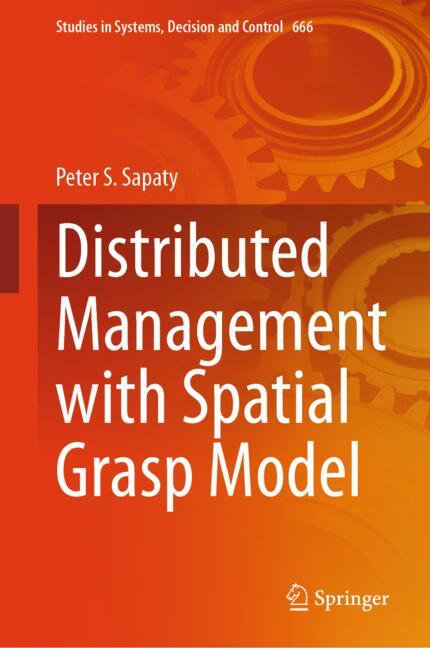
Distributed Management with Spatial Grasp Model
☆☆☆☆☆
(0 reviews)
Lowest price (incl. delivery)
13 752,00 JPY
Typical price6 920,25 PLN
Lowest (90 days)113,50 PLN
Offers2
Last updated1 สัปดาห์ที่แล้ว
| ผู้ขาย | Product price | Delivery | รวม | ความพร้อมจำหน่าย | Updated | |
|---|---|---|---|---|---|---|
| SP Springer Nature Author | 13 727,00 JPY | 25,00 JPY | 13 752,00 JPY | มีจำหน่าย | 1 สัปดาห์ที่แล้ว | View offer |
| SP SpringerNatureLink Shop INT | 113,50 EUR | 25,00 EUR | 138,50 EUR | มีจำหน่าย | 1 สัปดาห์ที่แล้ว | View offer |
ราคาและความพร้อมจำหน่ายอาจมีการเปลี่ยนแปลง อัปเดตล่าสุด: 08.08.2026 23:22.
EAN
9783032193780
Springer Nature
0,0
☆☆☆☆☆
0 reviews
5★
0%
4★
0%
3★
0%
2★
0%
1★
0%
Product reviews
No reviews yet — be the first!
The word “spatial” fundamentally relates to human existence and activity in any terrestrial and celestial spaces. It refers to the location, arrangement, and distribution of things, including human activities, people, and resources, across the Earth's surface and within physical and virtual environments. The book provides philosophical, psychological, and technological approach for investigation and management of any spatial organizations and systems, using for this the developed, patented and published in eleven books Spatial Grasp Model and Technology (SGT) based on spatial coverage and management of distributed dynamic systems. It historically evolved from the WAVE approach which allowed more than half a century ago for implementation of citywide computer networks, before the internet. It will compares SGT with the concept of algorithm confirming universality of the former for spatial and distributed systems, with the latter just being tools for concrete applications, and with massive spatial phenomena like virus, smog, radiation, rain, etc. which are far more general and global than algorithmic sequences. The self-organizing spatial features of the approach may also relate to non-algorithmic ideas becoming popular especially in relation to living organisms and societies where traditional algorithmic models are becoming insufficient. The book is oriented on system scientists, application programmers, industry managers, defence and security commanders, emergency agencies, university students, philosophers, psychologists too.
Similar products
 50 Years of Philosophy and Medicine
from $107.30
50 Years of Philosophy and Medicine
from $107.30
 Understanding Cybersecurity Law and Digital Privacy
from $122.63
Understanding Cybersecurity Law and Digital Privacy
from $122.63
 Decisions in International Trade and Logistics
from $122.63
Decisions in International Trade and Logistics
from $122.63
 Advances in Economic Measurement
from $122.63
Advances in Economic Measurement
from $122.63
 Nanomaterials
from $137.96
Nanomaterials
from $137.96
 Sustainable Scaffolds-based Strategies in Tissue Engineering and Regenerative Medicine
from $162.87
Sustainable Scaffolds-based Strategies in Tissue Engineering and Regenerative Medicine
from $162.87
 Narratives in Educational Research
from $162.87
Narratives in Educational Research
from $162.87
 Environmental Biology of the Young Chinese Sturgeon
from $210.78
Environmental Biology of the Young Chinese Sturgeon
from $210.78