
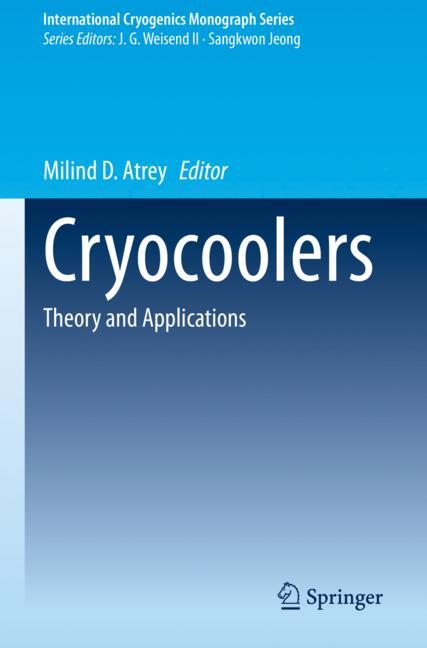
Cryocoolers
☆☆☆☆☆
(0 reviews)
Lowest price (incl. delivery)
25 739,00 JPY
Typical price210,08 PLN
Lowest (90 days)197,99 PLN
Offers3
Last updated2 วันที่แล้ว
Price history (90 days)
Full history
2026-08-08
2026-08-15
| อัปเดตเมื่อ | ราคา |
|---|---|
| 2026-08-08 | 197,99 |
| 2026-08-15 | 212,50 |
| ผู้ขาย | Product price | Delivery | รวม | ความพร้อมจำหน่าย | Updated | |
|---|---|---|---|---|---|---|
| SP SpringerNatureLink Shop INT | 25 739,00 JPY | free | 25 739,00 JPY | มีจำหน่าย | 2 วันที่แล้ว | View offer |
| SP SpringerNatureLink Shop INT | 212,50 EUR | 15,00 EUR | 227,50 EUR | มีจำหน่าย | 2 วันที่แล้ว | View offer |
| SP Springer Nature Author | 212,50 EUR | 15,00 EUR | 227,50 EUR | มีจำหน่าย | 1 สัปดาห์ที่แล้ว | View offer |
ราคาและความพร้อมจำหน่ายอาจมีการเปลี่ยนแปลง อัปเดตล่าสุด: 15.08.2026 08:13.
EAN
9783030430764
Springer Nature
0,0
☆☆☆☆☆
0 reviews
5★
0%
4★
0%
3★
0%
2★
0%
1★
0%
Product reviews
No reviews yet — be the first!
This book serves as an introduction to cryocooler technology and describes the principle applications of cryocoolers across a broad range of fields. It covers the specific requirements of these applications, and describes how the advantages and disadvantages of different cryocooler systems are taken into consideration. For example, Stirling coolers tend to be used only in space applications because of their high coefficient of performance, low weight and proven reliability, whilst Gifford-McMahon coolers are used for ground applications, such as in cryopumps and MRI shield cooling applications. Joule-Thomson cryocoolers are used in missile technology because of the fast cool down requirements. The cryocooler field is fast developing and the number of applications are growing because of the increasing costs of the cryogens such as Helium and Neon. The first chapter of the book introduces the different types of cryocoolers, their classification, working principles, and their design aspects, and briefly mentions some of the applications of these systems. This introductory chapter is followed by a number of contributions from prominent international researchers, each describing a specific field of application, the cooling requirements and the cryocooler systems employed. These areas of application include gas liquefaction, space technology, medical science, dilution refrigerators, missile systems, and physics research including particle accelerators. Each chapter describes the cooling requirements based on the end use, the approximate cooling load calculations, the criteria for cryocooler selection, the arrangement for cryocooler placement, the connection of the cooler to the object to be cooled, and includes genuine case studies. Intended primarily for researchers working on cryocoolers, the book will also serve as an introduction to cryocooler technology for students, and a useful reference for those using cryocooler systems in any area of application.
Similar products
 50 Years of Philosophy and Medicine
from $107.30
50 Years of Philosophy and Medicine
from $107.30
 Understanding Cybersecurity Law and Digital Privacy
from $122.63
Understanding Cybersecurity Law and Digital Privacy
from $122.63
 Decisions in International Trade and Logistics
from $122.63
Decisions in International Trade and Logistics
from $122.63
 Advances in Economic Measurement
from $122.63
Advances in Economic Measurement
from $122.63
 Nanomaterials
from $137.96
Nanomaterials
from $137.96
 Sustainable Scaffolds-based Strategies in Tissue Engineering and Regenerative Medicine
from $162.87
Sustainable Scaffolds-based Strategies in Tissue Engineering and Regenerative Medicine
from $162.87
 Narratives in Educational Research
from $162.87
Narratives in Educational Research
from $162.87
 Environmental Biology of the Young Chinese Sturgeon
from $210.78
Environmental Biology of the Young Chinese Sturgeon
from $210.78