
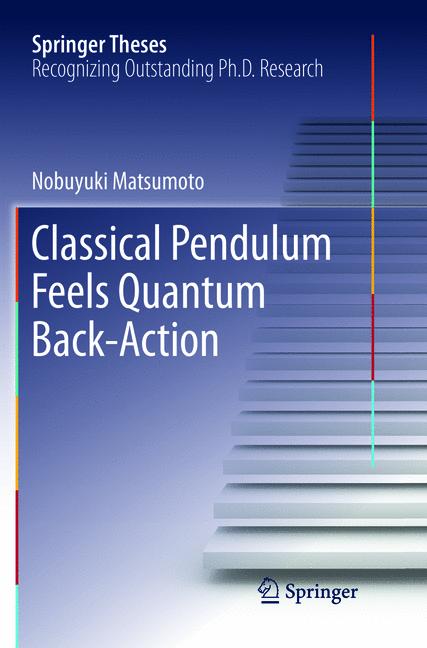
Classical Pendulum Feels Quantum Back-Action
☆☆☆☆☆
(0 reviews)
Lowest price (incl. delivery)
14 324,00 JPY
Typical price1 089,65 PLN
Lowest (90 days)71,50 PLN
Offers6
Last updated1 สัปดาห์ที่แล้ว
Price history (90 days)
Full history
2026-08-08
2026-08-15
| อัปเดตเมื่อ | ราคา |
|---|---|
| 2026-08-08 | 84,99 |
| 2026-08-15 | 71,50 |
| ผู้ขาย | Product price | Delivery | รวม | ความพร้อมจำหน่าย | Updated | |
|---|---|---|---|---|---|---|
| SP SpringerNatureLink Shop INT | 14 299,00 JPY | 25,00 JPY | 14 324,00 JPY | มีจำหน่าย | 6 วันที่แล้ว | View offer |
| SP Springer Nature Author | 14 299,00 JPY | 15,00 JPY | 14 314,00 JPY | มีจำหน่าย | 1 สัปดาห์ที่แล้ว | View offer |
| SP SpringerNatureLink Shop INT | 99,99 USD | 19,00 USD | 118,99 USD | มีจำหน่าย | 6 วันที่แล้ว | View offer |
| SP SpringerNatureLink Shop INT | 109,99 USD | 25,00 USD | 134,99 USD | มีจำหน่าย | 6 วันที่แล้ว | View offer |
| SP SpringerNatureLink Shop INT | 109,99 USD | 15,00 USD | 124,99 USD | มีจำหน่าย | 6 วันที่แล้ว | View offer |
| SP SpringerNatureLink Shop INT | 118,00 EUR | 19,00 EUR | 137,00 EUR | มีจำหน่าย | 6 วันที่แล้ว | View offer |
ราคาและความพร้อมจำหน่ายอาจมีการเปลี่ยนแปลง อัปเดตล่าสุด: 08.08.2026 23:21.
0,0
☆☆☆☆☆
0 reviews
5★
0%
4★
0%
3★
0%
2★
0%
1★
0%
Product reviews
No reviews yet — be the first!
In this thesis, ultimate sensitive measurement for weak force imposed on a suspended mirror is performed with the help of a laser and an optical cavity for the development of gravitational-wave detectors. According to the Heisenberg uncertainty principle, such measurements are subject to a fundamental noise called quantum noise, which arises from the quantum nature of a probe (light) and a measured object (mirror). One of the sources of quantum noise is the quantum back-action, which arises from the vacuum fluctuation of the light. It sways the mirror via the momentum transferred to the mirror upon its reflection for the measurement. The author discusses a fundamental trade-off between sensitivity and stability in the macroscopic system, and suggests using a triangular cavity that can avoid this trade-off. The development of an optical triangular cavity is described and its characterization of the optomechanical effect in the triangular cavity is demonstrated. As a result, for the first time in the world the quantum back-action imposed on the 5-mg suspended mirror is significantly evaluated. This work contributes to overcoming the standard quantum limit in the future.
Similar products
 50 Years of Philosophy and Medicine
from $107.30
50 Years of Philosophy and Medicine
from $107.30
 Understanding Cybersecurity Law and Digital Privacy
from $122.63
Understanding Cybersecurity Law and Digital Privacy
from $122.63
 Decisions in International Trade and Logistics
from $122.63
Decisions in International Trade and Logistics
from $122.63
 Advances in Economic Measurement
from $122.63
Advances in Economic Measurement
from $122.63
 Nanomaterials
from $137.96
Nanomaterials
from $137.96
 Sustainable Scaffolds-based Strategies in Tissue Engineering and Regenerative Medicine
from $162.87
Sustainable Scaffolds-based Strategies in Tissue Engineering and Regenerative Medicine
from $162.87
 Narratives in Educational Research
from $162.87
Narratives in Educational Research
from $162.87
 Environmental Biology of the Young Chinese Sturgeon
from $210.78
Environmental Biology of the Young Chinese Sturgeon
from $210.78