
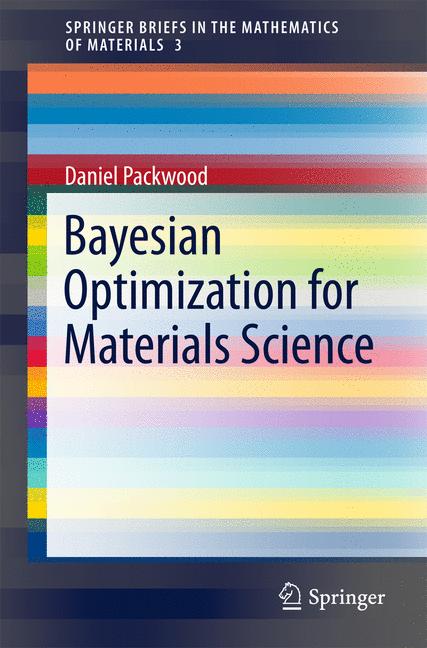
Bayesian Optimization for Materials Science
☆☆☆☆☆
(0 reviews)
Lowest price (incl. delivery)
62,05 EUR
Typical price3 739,03 PLN
Lowest (90 days)43,05 PLN
Offers3
Last updated1 สัปดาห์ที่แล้ว
| ผู้ขาย | Product price | Delivery | รวม | ความพร้อมจำหน่าย | Updated | |
|---|---|---|---|---|---|---|
| SP SpringerNatureLink Shop INT | 43,05 EUR | 19,00 EUR | 62,05 EUR | มีจำหน่าย | 1 วันที่แล้ว | View offer |
| SP SpringerNatureLink Shop INT | 7 435,00 JPY | 25,00 JPY | 7 460,00 JPY | มีจำหน่าย | 1 วันที่แล้ว | View offer |
| SP Springer Nature Author | 7 435,00 JPY | 19,00 JPY | 7 454,00 JPY | มีจำหน่าย | 1 สัปดาห์ที่แล้ว | View offer |
ราคาและความพร้อมจำหน่ายอาจมีการเปลี่ยนแปลง อัปเดตล่าสุด: 08.08.2026 23:16.
EAN
9789811067815
Springer Nature
0,0
☆☆☆☆☆
0 reviews
5★
0%
4★
0%
3★
0%
2★
0%
1★
0%
Product reviews
No reviews yet — be the first!
This book provides a short and concise introduction to Bayesian optimization specifically for experimental and computational materials scientists. After explaining the basic idea behind Bayesian optimization and some applications to materials science in Chapter 1, the mathematical theory of Bayesian optimization is outlined in Chapter 2. Finally, Chapter 3 discusses an application of Bayesian optimization to a complicated structure optimization problem in computational surface science. Bayesian optimization is a promising global optimization technique that originates in the field of machine learning and is starting to gain attention in materials science. For the purpose of materials design, Bayesian optimization can be used to predict new materials with novel properties without extensive screening of candidate materials. For the purpose of computational materials science, Bayesian optimization can be incorporated into first-principles calculations to perform efficient, global structure optimizations. While research in these directions has been reported in high-profile journals, until now there has been no textbook aimed specifically at materials scientists who wish to incorporate Bayesian optimization into their own research. This book will be accessible to researchers and students in materials science who have a basic background in calculus and linear algebra.
Similar products
 50 Years of Philosophy and Medicine
from $107.30
50 Years of Philosophy and Medicine
from $107.30
 Understanding Cybersecurity Law and Digital Privacy
from $122.63
Understanding Cybersecurity Law and Digital Privacy
from $122.63
 Decisions in International Trade and Logistics
from $122.63
Decisions in International Trade and Logistics
from $122.63
 Advances in Economic Measurement
from $122.63
Advances in Economic Measurement
from $122.63
 Nanomaterials
from $137.96
Nanomaterials
from $137.96
 Sustainable Scaffolds-based Strategies in Tissue Engineering and Regenerative Medicine
from $162.87
Sustainable Scaffolds-based Strategies in Tissue Engineering and Regenerative Medicine
from $162.87
 Narratives in Educational Research
from $162.87
Narratives in Educational Research
from $162.87
 Environmental Biology of the Young Chinese Sturgeon
from $210.78
Environmental Biology of the Young Chinese Sturgeon
from $210.78