
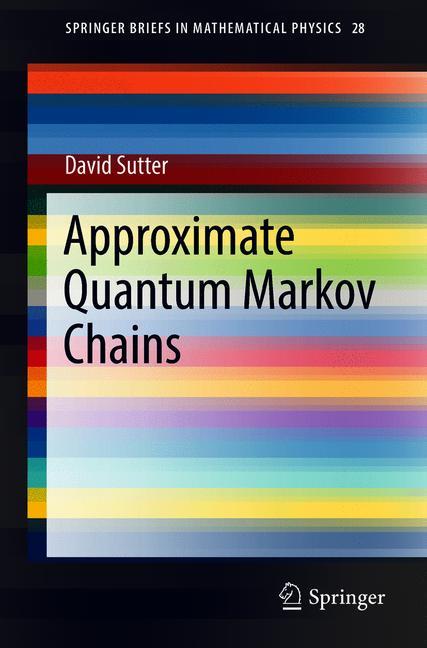
Approximate Quantum Markov Chains
☆☆☆☆☆
(0 reviews)
Lowest price (incl. delivery)
7 164,00 JPY
Typical price524,53 PLN
Lowest (90 days)35,99 PLN
Offers6
Last updated1 สัปดาห์ที่แล้ว
Price history (90 days)
Full history
2026-08-08
2026-08-15
| อัปเดตเมื่อ | ราคา |
|---|---|
| 2026-08-08 | 39,99 |
| 2026-08-14 | 35,99 |
| 2026-08-15 | 51,99 |
| ผู้ขาย | Product price | Delivery | รวม | ความพร้อมจำหน่าย | Updated | |
|---|---|---|---|---|---|---|
| SP SpringerNatureLink Shop INT | 7 149,00 JPY | 15,00 JPY | 7 164,00 JPY | มีจำหน่าย | 6 วันที่แล้ว | View offer |
| SP Springer Nature Author | 7 149,00 JPY | free | 7 149,00 JPY | มีจำหน่าย | 1 สัปดาห์ที่แล้ว | View offer |
| SP SpringerNatureLink Shop INT | 49,99 USD | 15,00 USD | 64,99 USD | มีจำหน่าย | 6 วันที่แล้ว | View offer |
| SP SpringerNatureLink Shop INT | 54,99 USD | free | 54,99 USD | มีจำหน่าย | 6 วันที่แล้ว | View offer |
| SP SpringerNatureLink Shop INT | 54,99 USD | free | 54,99 USD | มีจำหน่าย | 6 วันที่แล้ว | View offer |
| SP SpringerNatureLink Shop INT | 59,00 EUR | 29,00 EUR | 88,00 EUR | มีจำหน่าย | 6 วันที่แล้ว | View offer |
ราคาและความพร้อมจำหน่ายอาจมีการเปลี่ยนแปลง อัปเดตล่าสุด: 08.08.2026 23:09.
0,0
☆☆☆☆☆
0 reviews
5★
0%
4★
0%
3★
0%
2★
0%
1★
0%
Product reviews
No reviews yet — be the first!
This book is an introduction to quantum Markov chains and explains how this concept is connected to the question of how well a lost quantum mechanical system can be recovered from a correlated subsystem. To achieve this goal, we strengthen the data-processing inequality such that it reveals a statement about the reconstruction of lost information. The main difficulty in order to understand the behavior of quantum Markov chains arises from the fact that quantum mechanical operators do not commute in general. As a result we start by explaining two techniques of how to deal with non-commuting matrices: the spectral pinching method and complex interpolation theory. Once the reader is familiar with these techniques a novel inequality is presented that extends the celebrated Golden-Thompson inequality to arbitrarily many matrices. This inequality is the key ingredient in understanding approximate quantum Markov chains and it answers a question from matrix analysis that was open since 1973, i.e., if Lieb's triple matrix inequality can be extended to more than three matrices. Finally, we carefully discuss the properties of approximate quantum Markov chains and their implications. The book is aimed to graduate students who want to learn about approximate quantum Markov chains as well as more experienced scientists who want to enter this field. Mathematical majority is necessary, but no prior knowledge of quantum mechanics is required.
Similar products
 50 Years of Philosophy and Medicine
from $107.30
50 Years of Philosophy and Medicine
from $107.30
 Understanding Cybersecurity Law and Digital Privacy
from $122.63
Understanding Cybersecurity Law and Digital Privacy
from $122.63
 Decisions in International Trade and Logistics
from $122.63
Decisions in International Trade and Logistics
from $122.63
 Advances in Economic Measurement
from $122.63
Advances in Economic Measurement
from $122.63
 Nanomaterials
from $137.96
Nanomaterials
from $137.96
 Sustainable Scaffolds-based Strategies in Tissue Engineering and Regenerative Medicine
from $162.87
Sustainable Scaffolds-based Strategies in Tissue Engineering and Regenerative Medicine
from $162.87
 Narratives in Educational Research
from $162.87
Narratives in Educational Research
from $162.87
 Environmental Biology of the Young Chinese Sturgeon
from $210.78
Environmental Biology of the Young Chinese Sturgeon
from $210.78