
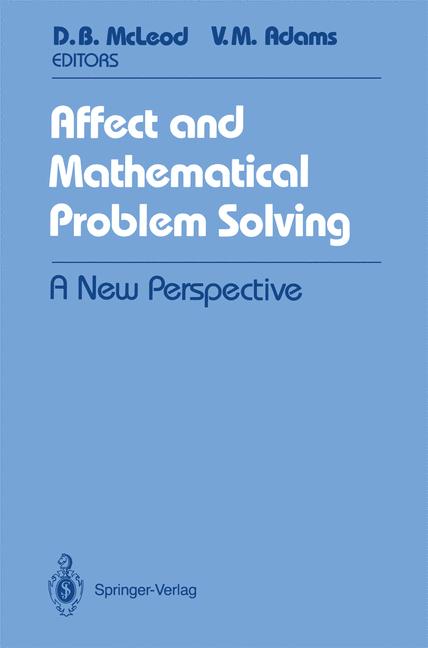
Affect and Mathematical Problem Solving
☆☆☆☆☆
(0 reviews)
Lowest price (incl. delivery)
7 149,00 JPY
Typical price416,51 PLN
Lowest (90 days)44,99 PLN
Offers7
Last updated1 สัปดาห์ที่แล้ว
Price history (90 days)
Full history
2026-08-08
2026-08-15
| อัปเดตเมื่อ | ราคา |
|---|---|
| 2026-08-08 | 49,99 |
| 2026-08-14 | 44,99 |
| 2026-08-15 | 51,99 |
| ผู้ขาย | Product price | Delivery | รวม | ความพร้อมจำหน่าย | Updated | |
|---|---|---|---|---|---|---|
| SP SpringerNatureLink Shop INT | 7 149,00 JPY | free | 7 149,00 JPY | มีจำหน่าย | 2 วันที่แล้ว | View offer |
| SP Springer Nature Author | 7 149,00 JPY | 29,00 JPY | 7 178,00 JPY | มีจำหน่าย | 1 สัปดาห์ที่แล้ว | View offer |
| SP SpringerNatureLink Shop INT | 49,99 USD | 25,00 USD | 74,99 USD | มีจำหน่าย | 2 วันที่แล้ว | View offer |
| SP SpringerNatureLink Shop INT | 54,99 USD | free | 54,99 USD | มีจำหน่าย | 2 วันที่แล้ว | View offer |
| SP SpringerNatureLink Shop INT | 54,99 USD | free | 54,99 USD | มีจำหน่าย | 2 วันที่แล้ว | View offer |
| SP SpringerNatureLink Shop INT | 54,99 USD | 25,00 USD | 79,99 USD | มีจำหน่าย | 2 วันที่แล้ว | View offer |
| SP SpringerNatureLink Shop INT | 59,00 EUR | 15,00 EUR | 74,00 EUR | มีจำหน่าย | 2 วันที่แล้ว | View offer |
ราคาและความพร้อมจำหน่ายอาจมีการเปลี่ยนแปลง อัปเดตล่าสุด: 08.08.2026 23:12.
0,0
☆☆☆☆☆
0 reviews
5★
0%
4★
0%
3★
0%
2★
0%
1★
0%
Product reviews
No reviews yet — be the first!
Research on cognitive aspects of mathematical problem solving has made great progress in recent years, but the relationship of affective factors to problem-solving performance has been a neglected research area. The purpose of Affect and Mathematical Problem Solving: A New Perspective is to show how the theories and methods of cognitive science can be extended to include the role of affect in mathematical problem solving. The book presents Mandler's theory of emotion and explores its implications for the learning and teaching of mathematical problem solving. Also, leading researchers from mathematics, education, and psychology report how they have integrated affect into their own cognitive research. The studies focus on metacognitive processes, aesthetic influences on expert problem solvers, teacher decision-making, technology and teaching problem solving, and beliefs about mathematics. The results suggest how emotional factors like anxiety, frustration, joy, and satisfaction can help or hinder performance in problem solving.
Similar products
 50 Years of Philosophy and Medicine
from $107.30
50 Years of Philosophy and Medicine
from $107.30
 Understanding Cybersecurity Law and Digital Privacy
from $122.63
Understanding Cybersecurity Law and Digital Privacy
from $122.63
 Decisions in International Trade and Logistics
from $122.63
Decisions in International Trade and Logistics
from $122.63
 Advances in Economic Measurement
from $122.63
Advances in Economic Measurement
from $122.63
 Nanomaterials
from $137.96
Nanomaterials
from $137.96
 Sustainable Scaffolds-based Strategies in Tissue Engineering and Regenerative Medicine
from $162.87
Sustainable Scaffolds-based Strategies in Tissue Engineering and Regenerative Medicine
from $162.87
 Narratives in Educational Research
from $162.87
Narratives in Educational Research
from $162.87
 Environmental Biology of the Young Chinese Sturgeon
from $210.78
Environmental Biology of the Young Chinese Sturgeon
from $210.78