
Pulsars
☆☆☆☆☆
(0 reviews)
Lowest price (incl. delivery)
7 149,00 JPY
Typical price491,72 PLN
Lowest (90 days)44,99 PLN
Offers6
Last updatedför 1 vecka sedan
Price history (90 days)
Full history
2026-08-08
2026-08-15
| Uppdaterad | Pris |
|---|---|
| 2026-08-08 | 49,99 |
| 2026-08-14 | 44,99 |
| 2026-08-15 | 51,99 |
| Säljare | Product price | Delivery | Totalt | Tillgänglighet | Updated | |
|---|---|---|---|---|---|---|
| SP SpringerNatureLink Shop INT | 7 149,00 JPY | free | 7 149,00 JPY | Tillgänglig | för 2 dagar sedan | View offer |
| SP Springer Nature Author | 7 149,00 JPY | 29,00 JPY | 7 178,00 JPY | Tillgänglig | för 1 vecka sedan | View offer |
| SP SpringerNatureLink Shop INT | 49,99 USD | free | 49,99 USD | Tillgänglig | för 2 dagar sedan | View offer |
| SP SpringerNatureLink Shop INT | 54,99 USD | 25,00 USD | 79,99 USD | Tillgänglig | för 2 dagar sedan | View offer |
| SP SpringerNatureLink Shop INT | 54,99 USD | free | 54,99 USD | Tillgänglig | för 2 dagar sedan | View offer |
| SP SpringerNatureLink Shop INT | 59,00 EUR | 15,00 EUR | 74,00 EUR | Tillgänglig | för 2 dagar sedan | View offer |
Priser och tillgänglighet kan ändras. Senast uppdaterad: 08.08.2026 23:14.
0,0
☆☆☆☆☆
0 reviews
5★
0%
4★
0%
3★
0%
2★
0%
1★
0%
Product reviews
No reviews yet — be the first!
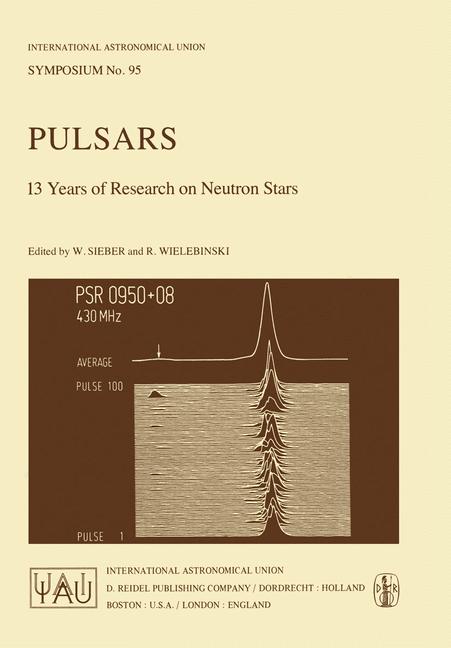
More than a decade has passed since pulsars were discovered at Cambridge by J. Bell and A. Hewish. The past 13 years have seen ex tensive and at first rather hectic research, and a considerable amount of observational and theoretical knowledge has been accumulated. Looking back over one decade of pulsar research, it seems worth while to ask what the real impact of the detection was and if our view of the universe has changed as a result of this discovery. The excite ment of the first months and years has ebbed down considerably, with the result that pulsar research has become the task of a few scientists, working in small groups, scattered over many countries. As more and more knowledge was acquired, pulsars changed eventually from the bizarre pUlsing objects -- as they were considered in the beginning -- to more normal stars of astrophysical interest. Still, pulsars are the manifestation of matter in its most extreme form -- neutron star matter -- for which an equivalent can be found on earth only in the very nucleus of an atom. Neutron stars were predicted quite early in the history of modern astrophysics, and although many of their features were already known from theoretical studies, astro physicists were not sure if we had the slightest chance to actually "see" these objects. It therefore took some time after the historical detection paper of Hewish and coworkers before astronomers became con vinced that pulsars were neutron stars.
Similar products
 50 Years of Philosophy and Medicine
from $107.30
50 Years of Philosophy and Medicine
from $107.30
 Understanding Cybersecurity Law and Digital Privacy
from $122.63
Understanding Cybersecurity Law and Digital Privacy
from $122.63
 Decisions in International Trade and Logistics
from $122.63
Decisions in International Trade and Logistics
from $122.63
 Advances in Economic Measurement
from $122.63
Advances in Economic Measurement
from $122.63
 Nanomaterials
from $137.96
Nanomaterials
from $137.96
 Sustainable Scaffolds-based Strategies in Tissue Engineering and Regenerative Medicine
from $162.87
Sustainable Scaffolds-based Strategies in Tissue Engineering and Regenerative Medicine
from $162.87
 Narratives in Educational Research
from $162.87
Narratives in Educational Research
from $162.87
 Environmental Biology of the Young Chinese Sturgeon
from $210.78
Environmental Biology of the Young Chinese Sturgeon
from $210.78