
Processor Architecture
☆☆☆☆☆
(0 reviews)
Lowest price (incl. delivery)
10 320,00 JPY
Typical price1 353,38 PLN
Lowest (90 days)63,99 PLN
Offers3
Last updatedför 6 dagar sedan
Price history (90 days)
Full history
2026-08-08
2026-08-15
| Uppdaterad | Pris |
|---|---|
| 2026-08-08 | 63,99 |
| 2026-08-15 | 63,99 |
| Säljare | Product price | Delivery | Totalt | Tillgänglighet | Updated | |
|---|---|---|---|---|---|---|
| SP SpringerNatureLink Shop INT | 10 295,00 JPY | 25,00 JPY | 10 320,00 JPY | Tillgänglig | för 54 minuter sedan | View offer |
| SP Springer Nature Author | 10 295,00 JPY | 15,00 JPY | 10 310,00 JPY | Tillgänglig | för 6 dagar sedan | View offer |
| SP SpringerNatureLink Shop INT | 85,00 EUR | 29,00 EUR | 114,00 EUR | Tillgänglig | för 6 timmar sedan | View offer |
Priser och tillgänglighet kan ändras. Senast uppdaterad: 08.08.2026 23:19.
EAN
9783642585890
Springer Nature
0,0
☆☆☆☆☆
0 reviews
5★
0%
4★
0%
3★
0%
2★
0%
1★
0%
Product reviews
No reviews yet — be the first!
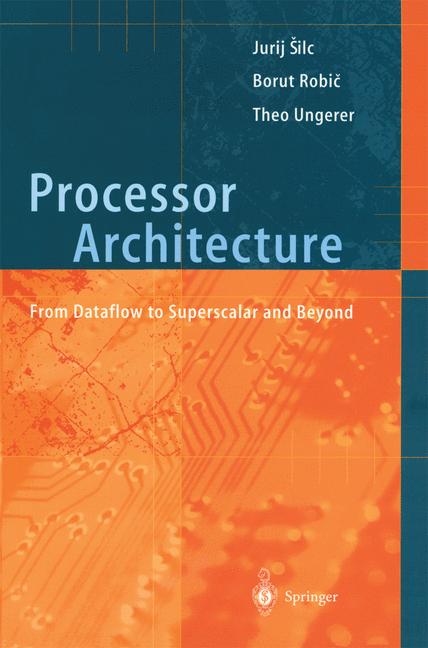
Today's microprocessors are the powerful descendants of the von Neumann 1 computer dating back to a memo of Burks, Goldstine, and von Neumann of 1946. The so-called von Neumann architecture is characterized by a se quential control flow resulting in a sequential instruction stream. A program counter addresses the next instruction if the preceding instruction is not a control instruction such as, e. g. , jump, branch, subprogram call or return. An instruction is coded in an instruction format of fixed or variable length, where the opcode is followed by one or more operands that can be data, addresses of data, or the address of an instruction in the case of a control instruction. The opcode defines the types of operands. Code and data are stored in a common storage that is linear, addressed in units of memory words (bytes, words, etc. ). The overwhelming design criterion of the von Neumann computer was the minimization of hardware and especially of storage. The most simple implementation of a von Neumann computer is characterized by a microar chitecture that defines a closely coupled control and arithmetic logic unit (ALU), a storage unit, and an I/O unit, all connected by a single connection unit. The instruction fetch by the control unit alternates with operand fetches and result stores for the AL U.
Similar products
 50 Years of Philosophy and Medicine
from $107.30
50 Years of Philosophy and Medicine
from $107.30
 Understanding Cybersecurity Law and Digital Privacy
from $122.63
Understanding Cybersecurity Law and Digital Privacy
from $122.63
 Decisions in International Trade and Logistics
from $122.63
Decisions in International Trade and Logistics
from $122.63
 Advances in Economic Measurement
from $122.63
Advances in Economic Measurement
from $122.63
 Nanomaterials
from $137.96
Nanomaterials
from $137.96
 Sustainable Scaffolds-based Strategies in Tissue Engineering and Regenerative Medicine
from $162.87
Sustainable Scaffolds-based Strategies in Tissue Engineering and Regenerative Medicine
from $162.87
 Narratives in Educational Research
from $162.87
Narratives in Educational Research
from $162.87
 Environmental Biology of the Young Chinese Sturgeon
from $210.78
Environmental Biology of the Young Chinese Sturgeon
from $210.78