
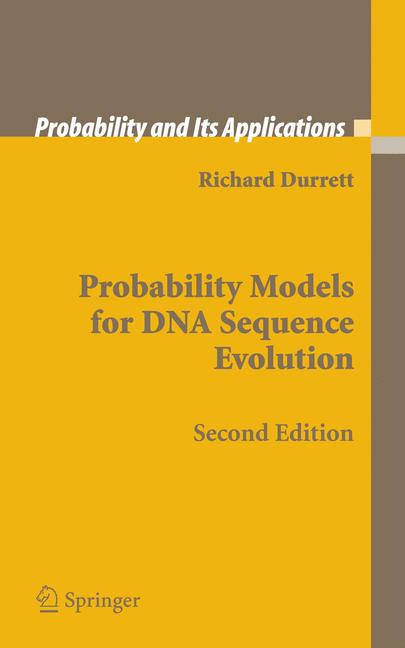
Probability Models for DNA Sequence Evolution
☆☆☆☆☆
(0 reviews)
Lowest price (incl. delivery)
17 178,00 JPY
Typical price1 716,23 PLN
Lowest (90 days)124,79 PLN
Offers6
Last updatedför 14 timmar sedan
Price history (90 days)
Full history
2026-08-08
2026-08-15
| Uppdaterad | Pris |
|---|---|
| 2026-08-08 | 124,79 |
| 2026-08-15 | 124,79 |
| Säljare | Product price | Delivery | Totalt | Tillgänglighet | Updated | |
|---|---|---|---|---|---|---|
| SP SpringerNatureLink Shop INT | 17 159,00 JPY | 19,00 JPY | 17 178,00 JPY | Tillgänglig | för 12 timmar sedan | View offer |
| SP Springer Nature Author | 17 159,00 JPY | 19,00 JPY | 17 178,00 JPY | Tillgänglig | för 6 dagar sedan | View offer |
| SP SpringerNatureLink Shop INT | 169,99 USD | 15,00 USD | 184,99 USD | Tillgänglig | för 14 timmar sedan | View offer |
| SP SpringerNatureLink Shop INT | 199,99 USD | 19,00 USD | 218,99 USD | Tillgänglig | för 14 timmar sedan | View offer |
| SP SpringerNatureLink Shop INT | 199,99 USD | 15,00 USD | 214,99 USD | Tillgänglig | för 14 timmar sedan | View offer |
| SP SpringerNatureLink Shop INT | 186,99 EUR | free | 186,99 EUR | Tillgänglig | för 14 timmar sedan | View offer |
Priser och tillgänglighet kan ändras. Senast uppdaterad: 15.08.2026 06:37.
0,0
☆☆☆☆☆
0 reviews
5★
0%
4★
0%
3★
0%
2★
0%
1★
0%
Product reviews
No reviews yet — be the first!
Our basic question is: Given a collection of DNA sequences, what underlying forces are responsible for the observed patterns of variability? To approach this question we introduce and analyze a number of probability models: the Wright-Fisher model, the coalescent, the infinite alleles model, and the infinite sites model. We study the complications that come from nonconstant population size, recombination, population subdivision, and three forms of natural selection: directional selection, balancing selection, and background selection. These theoretical results set the stage for the investigation of various statistical tests to detect departures from "neutral evolution". The final chapter studies the evolution of whole genomes by chromosomal inversions, reciprocal translocations, and genome duplication. Throughout the book, the theory is developed in close connection with data from more than 60 experimental studies from the biology literature that illustrate the use of these results. This book is written for mathematicians and for biologists alike. We assume no previous knowledge of concepts from biology and only a basic knowledge of probability: a one semester undergraduate course and some familiarity with Markov chains and Poisson processes.
Similar products
 50 Years of Philosophy and Medicine
from $107.30
50 Years of Philosophy and Medicine
from $107.30
 Understanding Cybersecurity Law and Digital Privacy
from $122.63
Understanding Cybersecurity Law and Digital Privacy
from $122.63
 Decisions in International Trade and Logistics
from $122.63
Decisions in International Trade and Logistics
from $122.63
 Advances in Economic Measurement
from $122.63
Advances in Economic Measurement
from $122.63
 Nanomaterials
from $137.96
Nanomaterials
from $137.96
 Sustainable Scaffolds-based Strategies in Tissue Engineering and Regenerative Medicine
from $162.87
Sustainable Scaffolds-based Strategies in Tissue Engineering and Regenerative Medicine
from $162.87
 Narratives in Educational Research
from $162.87
Narratives in Educational Research
from $162.87
 Environmental Biology of the Young Chinese Sturgeon
from $210.78
Environmental Biology of the Young Chinese Sturgeon
from $210.78