
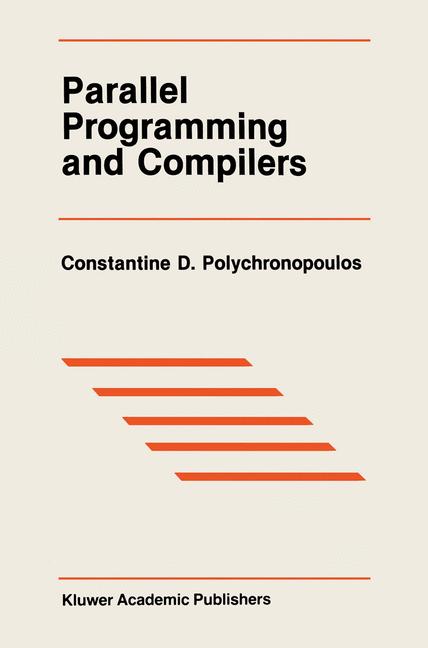
Parallel Programming and Compilers
☆☆☆☆☆
(0 reviews)
Lowest price (incl. delivery)
7 178,00 JPY
Typical price362,20 PLN
Lowest (90 days)49,99 PLN
Offers2
Last updatedför 6 timmar sedan
| Säljare | Product price | Delivery | Totalt | Tillgänglighet | Updated | |
|---|---|---|---|---|---|---|
| SP Springer Nature Author | 7 149,00 JPY | 29,00 JPY | 7 178,00 JPY | Tillgänglig | för 6 timmar sedan | View offer |
| SP SpringerNatureLink Shop INT | 59,00 EUR | free | 59,00 EUR | Tillgänglig | för 18 timmar sedan | View offer |
Priser och tillgänglighet kan ändras. Senast uppdaterad: 08.08.2026 23:12.
0,0
☆☆☆☆☆
0 reviews
5★
0%
4★
0%
3★
0%
2★
0%
1★
0%
Product reviews
No reviews yet — be the first!
The second half of the 1970s was marked with impressive advances in array/vector architectures and vectorization techniques and compilers. This progress continued with a particular focus on vector machines until the middle of the 1980s. The major ity of supercomputers during this period were register-to-register (Cray 1) or memory-to-memory (CDC Cyber 205) vector (pipelined) machines. However, the increasing demand for higher computational rates lead naturally to parallel comput ers and software. Through the replication of autonomous processors in a coordinated system, one can skip over performance barriers due technology limitations. In princi ple, parallelism offers unlimited performance potential. Nevertheless, it is very difficult to realize this performance potential in practice. So far, we have seen only the tip of the iceberg called "parallel machines and parallel programming". Parallel programming in particular is a rapidly evolving art and, at present, highly empirical. In this book we discuss several aspects of parallel programming and parallelizing compilers. Instead of trying to develop parallel programming methodologies and paradigms, we often focus on more advanced topics assuming that the reader has an adequate background in parallel processing. The book is organized in three main parts. In the first part (Chapters 1 and 2) we set the stage and focus on program transformations and parallelizing compilers. The second part of this book (Chapters 3 and 4) discusses scheduling for parallel machines from the practical point of view macro and microtasking and supporting environments). Finally, the last part (Le.
Similar products
 Patient Safety Coaching
from $91.97
Patient Safety Coaching
from $91.97
 Ethnography and Diversity
from $69.30
Ethnography and Diversity
from $69.30
 Smart Villages
from $91.97
Smart Villages
from $91.97
 Nuclear Non-Proliferation in International Law - Volume VI
from $91.97
Nuclear Non-Proliferation in International Law - Volume VI
from $91.97
 The Price of Freedom
from $91.97
The Price of Freedom
from $91.97
 Eco-Social Policy in the OECD and the World Bank
from $91.97
Eco-Social Policy in the OECD and the World Bank
from $91.97
 Special Topics in Policing
from $122.58
Special Topics in Policing
from $122.58
 Music from the Heart
from $91.97
Music from the Heart
from $91.97