
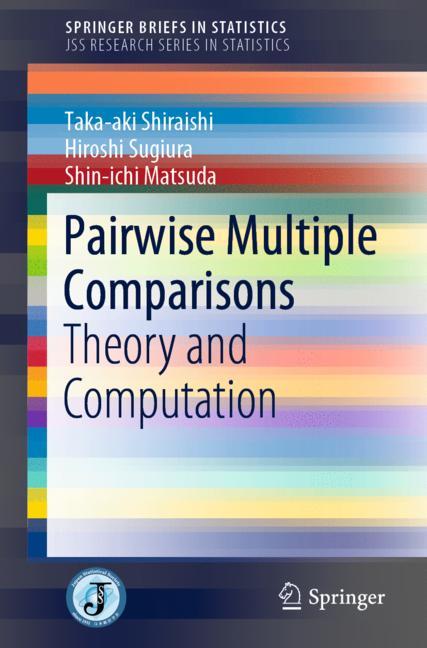
Pairwise Multiple Comparisons
☆☆☆☆☆
(0 reviews)
Lowest price (incl. delivery)
79,99 USD
Typical price55,22 PLN
Lowest (90 days)49,99 PLN
Offers2
Last updatedför 21 timmar sedan
| Säljare | Product price | Delivery | Totalt | Tillgänglighet | Updated | |
|---|---|---|---|---|---|---|
| SP SpringerNatureLink Shop INT | 64,99 USD | 15,00 USD | 79,99 USD | Tillgänglig | för 20 timmar sedan | View offer |
| SP Springer Nature Author | 64,99 USD | free | 64,99 USD | Tillgänglig | för 11 timmar sedan | View offer |
Priser och tillgänglighet kan ändras. Senast uppdaterad: 08.08.2026 11:04.
0,0
☆☆☆☆☆
0 reviews
5★
0%
4★
0%
3★
0%
2★
0%
1★
0%
Product reviews
No reviews yet — be the first!
This book focuses on all-pairwise multiple comparisons of means in multi-sample models, introducing closed testing procedures based on maximum absolute values of some two-sample t-test statistics and on F-test statistics in homoscedastic multi-sample models. It shows that (1) the multi-step procedures are more powerful than single-step procedures and the Ryan/Einot–Gabriel/Welsh tests, and (2) the confidence regions induced by the multi-step procedures are equivalent to simultaneous confidence intervals. Next, it describes the multi-step test procedure in heteroscedastic multi-sample models, which is superior to the single-step Games–Howell procedure. In the context of simple ordered restrictions of means, the authors also discuss closed testing procedures based on maximum values of two-sample one-sided t-test statistics and based on Bartholomew's statistics. Furthermore, the book presents distribution-free procedures and describes simulation studies performed under the null hypothesis and some alternative hypotheses. Although single-step multiple comparison procedures are generally used, the closed testing procedures described are more powerful than the single-step procedures. In order to execute the multiple comparison procedures, the upper 100α percentiles of the complicated distributions are required. Classical integral formulas such as Simpson's rule and the Gaussian rule have been used for the calculation of the integral transform that appears in statistical calculations. However, these formulas are not effective for the complicated distribution. As such, the authors introduce the sinc method, which is optimal in terms of accuracy and computational cost.
Similar products
 Patient Safety Coaching
from $91.97
Patient Safety Coaching
from $91.97
 Ethnography and Diversity
from $69.30
Ethnography and Diversity
from $69.30
 Smart Villages
from $91.97
Smart Villages
from $91.97
 Nuclear Non-Proliferation in International Law - Volume VI
from $91.97
Nuclear Non-Proliferation in International Law - Volume VI
from $91.97
 The Price of Freedom
from $91.97
The Price of Freedom
from $91.97
 Eco-Social Policy in the OECD and the World Bank
from $91.97
Eco-Social Policy in the OECD and the World Bank
from $91.97
 Special Topics in Policing
from $122.58
Special Topics in Policing
from $122.58
 Music from the Heart
from $91.97
Music from the Heart
from $91.97