
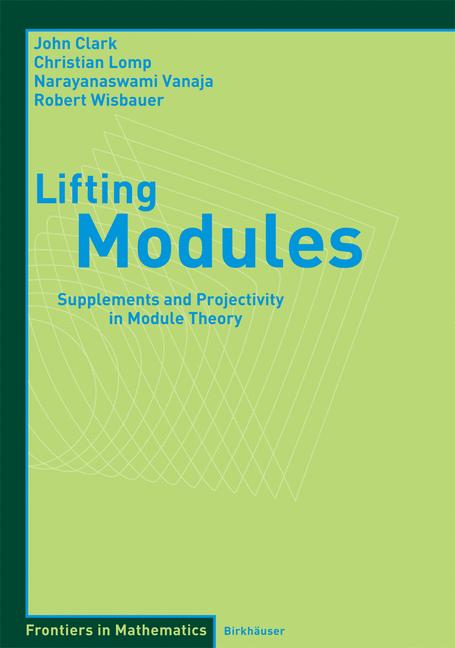
Lifting Modules
☆☆☆☆☆
(0 reviews)
Lowest price (incl. delivery)
52,01 AUD
Typical price767,16 PLN
Lowest (90 days)27,01 PLN
Offers5
Last updatedför 6 dagar sedan
Price history (90 days)
Full history
2026-08-08
2026-08-15
| Uppdaterad | Pris |
|---|---|
| 2026-08-08 | 27,01 |
| 2026-08-15 | 57,19 |
| Säljare | Product price | Delivery | Totalt | Tillgänglighet | Updated | |
|---|---|---|---|---|---|---|
| VI VitalSource | 27,01 AUD | 25,00 AUD | 52,01 AUD | Tillgänglig | för 1 vecka sedan | View offer |
| SP SpringerNatureLink Shop INT | 7 864,00 JPY | 15,00 JPY | 7 879,00 JPY | Tillgänglig | för 3 timmar sedan | View offer |
| SP Springer Nature Author | 7 864,00 JPY | 19,00 JPY | 7 883,00 JPY | Tillgänglig | för 6 dagar sedan | View offer |
| KN Knetbooks.com | 69,57 USD | 25,00 USD | 94,57 USD | Tillgänglig | för 6 dagar sedan | View offer |
| SP SpringerNatureLink Shop INT | 65,00 EUR | 15,00 EUR | 80,00 EUR | Tillgänglig | för 10 timmar sedan | View offer |
Priser och tillgänglighet kan ändras. Senast uppdaterad: 08.08.2026 11:46.
EAN
9783764375720
Springer Nature
0,0
☆☆☆☆☆
0 reviews
5★
0%
4★
0%
3★
0%
2★
0%
1★
0%
Product reviews
No reviews yet — be the first!
Extending modules are generalizations of injective modules and, dually, lifting modules generalize projective supplemented modules. There is a certain asymmetry in this duality. While the theory of extending modules is well documented in monographs and text books, the purpose of our monograph is to provide a thorough study of supplements and projectivity conditions needed to investigate classes of modules related to lifting modules. The text begins with an introduction to small submodules, the radical, variations on projectivity, and hollow dimension. The subsequent chapters consider preradicals and torsion theories (in particular related to small modules), decompositions of modules (including the exchange property and local semi-T-nilpotency), supplements in modules (with specific emphasis on semilocal endomorphism rings), finishing with a long chapter on lifting modules, leading up their use in the theory of perfect rings, Harada rings, and quasi-Frobenius rings. Most of the material in the monograph appears in book form for the first time. The main text is augmented by a plentiful supply of exercises together with comments on further related material and on how the theory has evolved.