
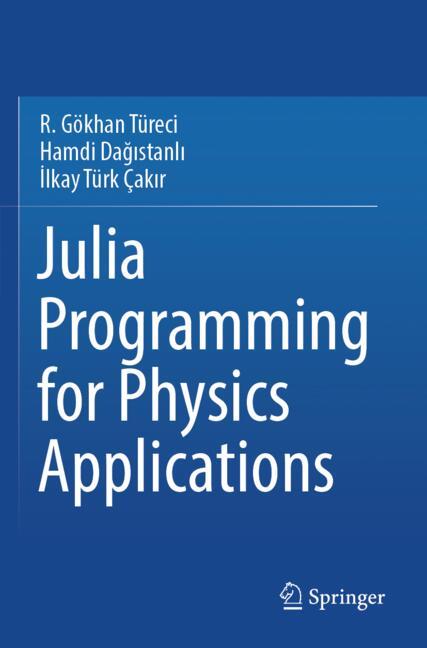
Julia Programming for Physics Applications
☆☆☆☆☆
(0 reviews)
Lowest price (incl. delivery)
22 879,00 JPY
Typical price1 930,38 PLN
Lowest (90 days)166,39 PLN
Offers6
Last updatedför 1 dag sedan
Price history (90 days)
Full history
2026-08-08
2026-08-15
| Uppdaterad | Pris |
|---|---|
| 2026-08-08 | 171,19 |
| 2026-08-15 | 166,39 |
| Säljare | Product price | Delivery | Totalt | Tillgänglighet | Updated | |
|---|---|---|---|---|---|---|
| SP SpringerNatureLink Shop INT | 22 879,00 JPY | free | 22 879,00 JPY | Tillgänglig | för 23 timmar sedan | View offer |
| SP Springer Nature Author | 22 879,00 JPY | free | 22 879,00 JPY | Tillgänglig | för 1 vecka sedan | View offer |
| SP SpringerNatureLink Shop INT | 219,99 USD | 29,00 USD | 248,99 USD | Tillgänglig | för 1 dag sedan | View offer |
| SP SpringerNatureLink Shop INT | 249,99 USD | free | 249,99 USD | Tillgänglig | för 1 dag sedan | View offer |
| SP SpringerNatureLink Shop INT | 249,99 USD | 19,00 USD | 268,99 USD | Tillgänglig | för 1 dag sedan | View offer |
| SP SpringerNatureLink Shop INT | 241,99 EUR | free | 241,99 EUR | Tillgänglig | för 1 dag sedan | View offer |
Priser och tillgänglighet kan ändras. Senast uppdaterad: 15.08.2026 07:18.
0,0
☆☆☆☆☆
0 reviews
5★
0%
4★
0%
3★
0%
2★
0%
1★
0%
Product reviews
No reviews yet — be the first!
Navigating the realm where physics intersects with programming, this book serves as an indispensable guide for students embarking on their journey with Julia. Whether it is plotting equations or analyzing experimental data, mastering computational tools is essential for unraveling the complexities of physical phenomena. Julia, an open-source programming language, emerges as the bridge between simplicity and efficiency. While Python, another open-source language, offers user-friendly syntax, its line-by-line execution often leads to sluggish performance. Julia, however, embodies the ethos of being "as easy as Python but as fast as C/C++," tailored specifically for scientific computing with ongoing developmental enhancements. Notably, Microsoft's AI assistant Copilot is crafted in Julia, showcasing its versatility and adaptability. Within these pages, readers encounter cutting-edge research illustrating Julia's prowess across diverse domains. From streamlined code composition facilitated by modular architecture to the integration of artificial intelligence and graphical visualization, this book illuminates Julia's multifaceted applications. It notably avoids delving into AI algorithms, instead focusing on equipping readers with foundational Julia skills applicable to physics problem-solving. Julia boasts an extensive library ecosystem tailored for scientific computing, empowering users with tools for tasks ranging from differential equation solving to statistical analysis. Its robust support for parallel processing enables swift computations on multi-core systems, a crucial asset for handling voluminous datasets with finesse. Starting with a primer on Julia fundamentals, the book gradually transitions to practical applications across various physics subdomains. From nuclear physics to high-energy phenomena, each chapter offers hands-on exercises that cement comprehension and foster proficiency in employing computational methods to unravel complex physical phenomena. Designed as a precursor to deeper explorations into AI applications within scientific realms, this book lays the groundwork for harnessing Julia's capabilities in physics-centric contexts.
Similar products
 50 Years of Philosophy and Medicine
from $107.30
50 Years of Philosophy and Medicine
from $107.30
 Understanding Cybersecurity Law and Digital Privacy
from $122.63
Understanding Cybersecurity Law and Digital Privacy
from $122.63
 Decisions in International Trade and Logistics
from $122.63
Decisions in International Trade and Logistics
from $122.63
 Advances in Economic Measurement
from $122.63
Advances in Economic Measurement
from $122.63
 Nanomaterials
from $137.96
Nanomaterials
from $137.96
 Sustainable Scaffolds-based Strategies in Tissue Engineering and Regenerative Medicine
from $162.87
Sustainable Scaffolds-based Strategies in Tissue Engineering and Regenerative Medicine
from $162.87
 Narratives in Educational Research
from $162.87
Narratives in Educational Research
from $162.87
 Environmental Biology of the Young Chinese Sturgeon
from $210.78
Environmental Biology of the Young Chinese Sturgeon
from $210.78