
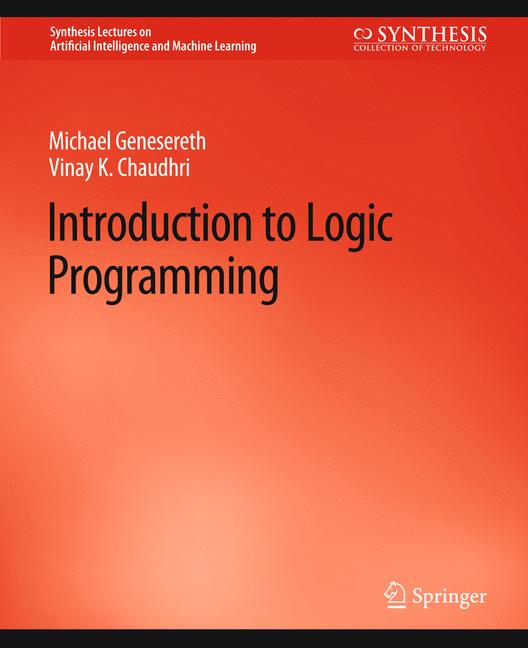
Introduction to Logic Programming
☆☆☆☆☆
(0 reviews)
Lowest price (incl. delivery)
60,99 USD
Typical price38,24 PLN
Lowest (90 days)30,79 PLN
Offers6
Last updatedför 1 vecka sedan
Price history (90 days)
Full history
2026-08-08
2026-08-15
| Uppdaterad | Pris |
|---|---|
| 2026-08-08 | 34,99 |
| 2026-08-14 | 30,79 |
| 2026-08-15 | 38,49 |
| Säljare | Product price | Delivery | Totalt | Tillgänglighet | Updated | |
|---|---|---|---|---|---|---|
| SP SpringerNatureLink Shop INT | 41,99 USD | 19,00 USD | 60,99 USD | Tillgänglig | för 3 dagar sedan | View offer |
| SP SpringerNatureLink Shop INT | 41,99 USD | free | 41,99 USD | Tillgänglig | för 3 dagar sedan | View offer |
| SP SpringerNatureLink Shop INT | 45,49 USD | 15,00 USD | 60,49 USD | Tillgänglig | för 3 dagar sedan | View offer |
| SP SpringerNatureLink Shop INT | 45,49 USD | free | 45,49 USD | Tillgänglig | för 3 dagar sedan | View offer |
| SP Springer Nature Author | 45,49 USD | 25,00 USD | 70,49 USD | Tillgänglig | för 1 vecka sedan | View offer |
| SP SpringerNatureLink Shop INT | 44,93 EUR | 29,00 EUR | 73,93 EUR | Tillgänglig | för 3 dagar sedan | View offer |
Priser och tillgänglighet kan ändras. Senast uppdaterad: 08.08.2026 10:44.
0,0
☆☆☆☆☆
0 reviews
5★
0%
4★
0%
3★
0%
2★
0%
1★
0%
Product reviews
No reviews yet — be the first!
Logic Programming is a style of programming in which programs take the form of sets of sentences in the language of Symbolic Logic. Over the years, there has been growing interest in Logic Programming due to applications in deductive databases, automated worksheets, Enterprise Management (business rules), Computational Law, and General Game Playing. This book introduces Logic Programming theory, current technology, and popular applications. In this volume, we take an innovative, model-theoretic approach to logic programming. We begin with the fundamental notion of datasets, i.e., sets of ground atoms. Given this fundamental notion, we introduce views, i.e., virtual relations; and we define classical logic programs as sets of view definitions, written using traditional Prolog-like notation but with semantics given in terms of datasets rather than implementation. We then introduce actions, i.e., additions and deletions of ground atoms; and we define dynamic logic programs as sets of action definitions. In addition to the printed book, there is an online version of the text with an interpreter and a compiler for the language used in the text and an integrated development environment for use in developing and deploying practical logic programs.
Similar products
 50 Years of Philosophy and Medicine
from $107.30
50 Years of Philosophy and Medicine
from $107.30
 Understanding Cybersecurity Law and Digital Privacy
from $122.63
Understanding Cybersecurity Law and Digital Privacy
from $122.63
 Decisions in International Trade and Logistics
from $122.63
Decisions in International Trade and Logistics
from $122.63
 Advances in Economic Measurement
from $122.63
Advances in Economic Measurement
from $122.63
 Nanomaterials
from $137.96
Nanomaterials
from $137.96
 Sustainable Scaffolds-based Strategies in Tissue Engineering and Regenerative Medicine
from $162.87
Sustainable Scaffolds-based Strategies in Tissue Engineering and Regenerative Medicine
from $162.87
 Narratives in Educational Research
from $162.87
Narratives in Educational Research
from $162.87
 Environmental Biology of the Young Chinese Sturgeon
from $210.78
Environmental Biology of the Young Chinese Sturgeon
from $210.78