
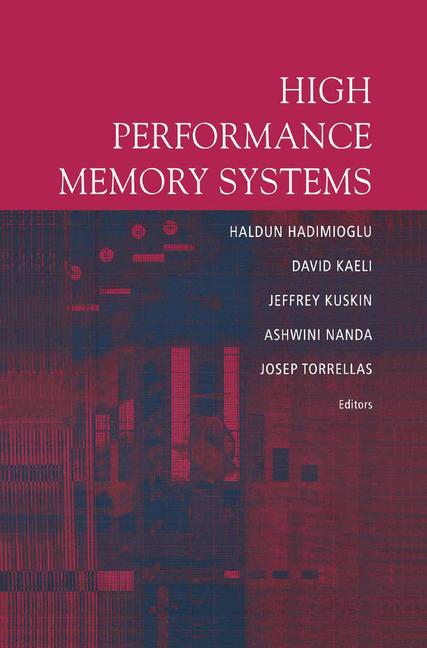
High Performance Memory Systems
☆☆☆☆☆
(0 reviews)
Lowest price (incl. delivery)
7 168,00 JPY
Typical price544,92 PLN
Lowest (90 days)44,99 PLN
Offers6
Last updatedför 1 vecka sedan
Price history (90 days)
Full history
2026-08-08
2026-08-15
| Uppdaterad | Pris |
|---|---|
| 2026-08-08 | 44,99 |
| 2026-08-14 | 44,99 |
| 2026-08-15 | 52,74 |
| Säljare | Product price | Delivery | Totalt | Tillgänglighet | Updated | |
|---|---|---|---|---|---|---|
| SP SpringerNatureLink Shop INT | 7 149,00 JPY | 19,00 JPY | 7 168,00 JPY | Tillgänglig | för 5 dagar sedan | View offer |
| SP Springer Nature Author | 7 149,00 JPY | free | 7 149,00 JPY | Tillgänglig | för 1 vecka sedan | View offer |
| SP SpringerNatureLink Shop INT | 49,99 USD | 25,00 USD | 74,99 USD | Tillgänglig | för 5 dagar sedan | View offer |
| SP SpringerNatureLink Shop INT | 54,99 USD | free | 54,99 USD | Tillgänglig | för 5 dagar sedan | View offer |
| SP SpringerNatureLink Shop INT | 54,99 USD | 29,00 USD | 83,99 USD | Tillgänglig | för 5 dagar sedan | View offer |
| SP SpringerNatureLink Shop INT | 59,00 EUR | free | 59,00 EUR | Tillgänglig | för 5 dagar sedan | View offer |
Priser och tillgänglighet kan ändras. Senast uppdaterad: 08.08.2026 23:11.
0,0
☆☆☆☆☆
0 reviews
5★
0%
4★
0%
3★
0%
2★
0%
1★
0%
Product reviews
No reviews yet — be the first!
The State of Memory Technology Over the past decade there has been rapid growth in the speed of micropro cessors. CPU speeds are approximately doubling every eighteen months, while main memory speed doubles about every ten years. The International Tech nology Roadmap for Semiconductors (ITRS) study suggests that memory will remain on its current growth path. The ITRS short-and long-term targets indicate continued scaling improvements at about the current rate by 2016. This translates to bit densities increasing at two times every two years until the introduction of 8 gigabit dynamic random access memory (DRAM) chips, after which densities will increase four times every five years. A similar growth pattern is forecast for other high-density chip areas and high-performance logic (e.g., microprocessors and application specific inte grated circuits (ASICs)). In the future, molecular devices, 64 gigabit DRAMs and 28 GHz clock signals are targeted. Although densities continue to grow, we still do not see significant advances that will improve memory speed. These trends have created a problem that has been labeled the Memory Wall or Memory Gap.
Similar products
 50 Years of Philosophy and Medicine
from $107.30
50 Years of Philosophy and Medicine
from $107.30
 Understanding Cybersecurity Law and Digital Privacy
from $122.63
Understanding Cybersecurity Law and Digital Privacy
from $122.63
 Decisions in International Trade and Logistics
from $122.63
Decisions in International Trade and Logistics
from $122.63
 Advances in Economic Measurement
from $122.63
Advances in Economic Measurement
from $122.63
 Nanomaterials
from $137.96
Nanomaterials
from $137.96
 Sustainable Scaffolds-based Strategies in Tissue Engineering and Regenerative Medicine
from $162.87
Sustainable Scaffolds-based Strategies in Tissue Engineering and Regenerative Medicine
from $162.87
 Narratives in Educational Research
from $162.87
Narratives in Educational Research
from $162.87
 Environmental Biology of the Young Chinese Sturgeon
from $210.78
Environmental Biology of the Young Chinese Sturgeon
from $210.78