
Elementary Functions:
☆☆☆☆☆
(0 reviews)
Lowest price (incl. delivery)
86,40 USD
Typical price68,52 PLN
Lowest (90 days)67,40 PLN
Offers6
Last updatedför 6 dagar sedan
Price history (90 days)
Full history
2026-08-08
2026-08-15
| Uppdaterad | Pris |
|---|---|
| 2026-08-08 | 67,40 |
| 2026-08-15 | 67,40 |
| Säljare | Product price | Delivery | Totalt | Tillgänglighet | Updated | |
|---|---|---|---|---|---|---|
| SP SpringerNatureLink Shop INT | 67,40 USD | 19,00 USD | 86,40 USD | Tillgänglig | för 10 timmar sedan | View offer |
| SP SpringerNatureLink Shop INT | 67,40 USD | 19,00 USD | 86,40 USD | Tillgänglig | för 10 timmar sedan | View offer |
| SP SpringerNatureLink Shop INT | 67,40 EUR | 29,00 EUR | 96,40 EUR | Tillgänglig | för 10 timmar sedan | View offer |
| SP SpringerNatureLink Shop INT | 74,99 USD | free | 74,99 USD | Tillgänglig | för 10 timmar sedan | View offer |
| SP SpringerNatureLink Shop INT | 74,99 USD | 25,00 USD | 99,99 USD | Tillgänglig | för 10 timmar sedan | View offer |
| SP Springer Nature Author | 74,99 USD | 29,00 USD | 103,99 USD | Tillgänglig | för 6 dagar sedan | View offer |
Priser och tillgänglighet kan ändras. Senast uppdaterad: 08.08.2026 12:13.
0,0
☆☆☆☆☆
0 reviews
5★
0%
4★
0%
3★
0%
2★
0%
1★
0%
Product reviews
No reviews yet — be the first!
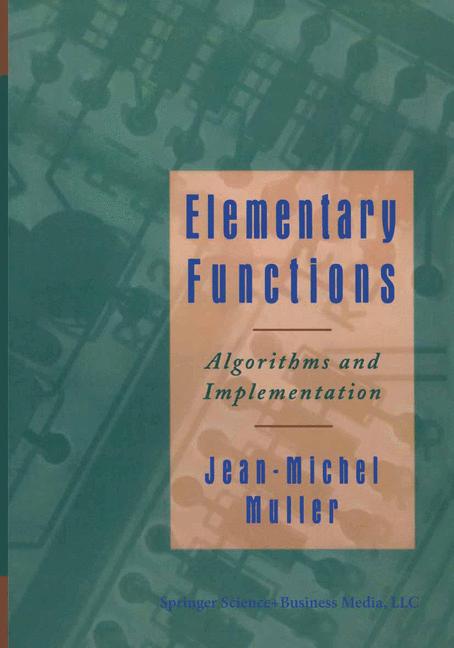
The elementary functions (sine, cosine, exponentials, logarithms . . . ) are the most commonly used mathematical functions. Computing them quickly and accurately is a major goal in computer arithmetic. This book gives the theoretical background necessary to understand and/or build algorithms for computing these functions, presents algorithms (hardware-oriented as well as software-oriented), and discusses issues related to the accurate floating-point implementation of these functions. My purpose was not to give "cooking recipes" that allow to implement some given functions on some given floating-point systems, but to provide the reader with the knowledge that is necessary to build, or adapt algorithms to his or her computing environment. When writing this book, I have had in mind two different audiences: specialists, who will have to design floating-point systems (hardware or soft ware parts) orto do research on algorithms, and inquiring minds, who just want to know what kind of methods are used to compute the math functions in current computers or pocket calculators. Because of this, the book is in tended to be helpful as well for postgraduate and advanced undergraduate students in computer science or applied mathematics as for professionals engaged in the design of algorithms, programs or circuits that implement floating-point arithmetic, or simply for engineers or scientists who want to improve their culture in that domain.
Similar products
 50 Years of Philosophy and Medicine
from $107.30
50 Years of Philosophy and Medicine
from $107.30
 Understanding Cybersecurity Law and Digital Privacy
from $122.63
Understanding Cybersecurity Law and Digital Privacy
from $122.63
 Decisions in International Trade and Logistics
from $122.63
Decisions in International Trade and Logistics
from $122.63
 Advances in Economic Measurement
from $122.63
Advances in Economic Measurement
from $122.63
 Nanomaterials
from $137.96
Nanomaterials
from $137.96
 Sustainable Scaffolds-based Strategies in Tissue Engineering and Regenerative Medicine
from $162.87
Sustainable Scaffolds-based Strategies in Tissue Engineering and Regenerative Medicine
from $162.87
 Narratives in Educational Research
from $162.87
Narratives in Educational Research
from $162.87
 Environmental Biology of the Young Chinese Sturgeon
from $210.78
Environmental Biology of the Young Chinese Sturgeon
from $210.78