
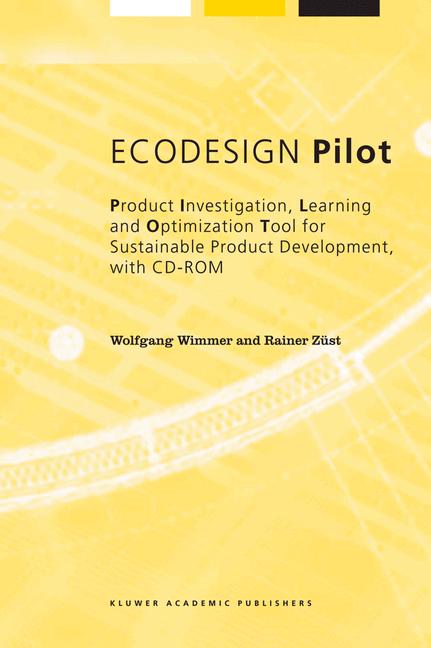
ECODESIGN Pilot
☆☆☆☆☆
(0 reviews)
Lowest price (incl. delivery)
7 164,00 JPY
Typical price527,12 PLN
Lowest (90 days)35,99 PLN
Offers6
Last updatedför 1 vecka sedan
Price history (90 days)
Full history
2026-08-08
2026-08-15
| Uppdaterad | Pris |
|---|---|
| 2026-08-08 | 39,99 |
| 2026-08-14 | 35,99 |
| 2026-08-15 | 51,99 |
| Säljare | Product price | Delivery | Totalt | Tillgänglighet | Updated | |
|---|---|---|---|---|---|---|
| SP SpringerNatureLink Shop INT | 7 149,00 JPY | 15,00 JPY | 7 164,00 JPY | Tillgänglig | för 6 dagar sedan | View offer |
| SP Springer Nature Author | 7 149,00 JPY | 25,00 JPY | 7 174,00 JPY | Tillgänglig | för 1 vecka sedan | View offer |
| SP SpringerNatureLink Shop INT | 49,99 USD | free | 49,99 USD | Tillgänglig | för 6 dagar sedan | View offer |
| SP SpringerNatureLink Shop INT | 54,99 USD | free | 54,99 USD | Tillgänglig | för 6 dagar sedan | View offer |
| SP SpringerNatureLink Shop INT | 54,99 USD | 19,00 USD | 73,99 USD | Tillgänglig | för 6 dagar sedan | View offer |
| SP SpringerNatureLink Shop INT | 59,00 EUR | free | 59,00 EUR | Tillgänglig | för 6 dagar sedan | View offer |
Priser och tillgänglighet kan ändras. Senast uppdaterad: 08.08.2026 23:08.
0,0
☆☆☆☆☆
0 reviews
5★
0%
4★
0%
3★
0%
2★
0%
1★
0%
Product reviews
No reviews yet — be the first!
Up to now, environmental policies have relied mainly on rules, regulations, and prohibitions. This kind of environmental policy -- a clearly reactive approach – has shown a mounting array of limitations. There is a clear need to seek new solutions, in particular those involving the initiative of firms themselves. Since the mid-1980’s, a new approach called “environmental management” has been established in research and practical applications; it is designed to systematically integrate environmental considerations into company activities. If, for instance, environmental objectives are being formulated for an enterprise, it is imperative to identify, highlight, and analyze real and significant environmental impacts of the firm's activities and to take appropriate measures to improve its performance. Controlling and implementing these environmental objectives requires suitable structures, procedures, and tools. Many motivated companies have approached the issue of environmental management through incorporating methods such “continual improvement processes” and “Life Cycle Assessment” into the various operational activities of the enterprise. Some firms initiated such transformation processes at their own production sites because it was easier to identify their own environmental impacts than to analyze, let alone mitigate, the effects of upstream and downstream processes. However, in many cases these processes are decisive factors in the overall environmental performance of a product. It has become clear that product design can influence these processes to a great extent.
Similar products
 50 Years of Philosophy and Medicine
from $107.30
50 Years of Philosophy and Medicine
from $107.30
 Understanding Cybersecurity Law and Digital Privacy
from $122.63
Understanding Cybersecurity Law and Digital Privacy
from $122.63
 Decisions in International Trade and Logistics
from $122.63
Decisions in International Trade and Logistics
from $122.63
 Advances in Economic Measurement
from $122.63
Advances in Economic Measurement
from $122.63
 Nanomaterials
from $137.96
Nanomaterials
from $137.96
 Sustainable Scaffolds-based Strategies in Tissue Engineering and Regenerative Medicine
from $162.87
Sustainable Scaffolds-based Strategies in Tissue Engineering and Regenerative Medicine
from $162.87
 Narratives in Educational Research
from $162.87
Narratives in Educational Research
from $162.87
 Environmental Biology of the Young Chinese Sturgeon
from $210.78
Environmental Biology of the Young Chinese Sturgeon
from $210.78