
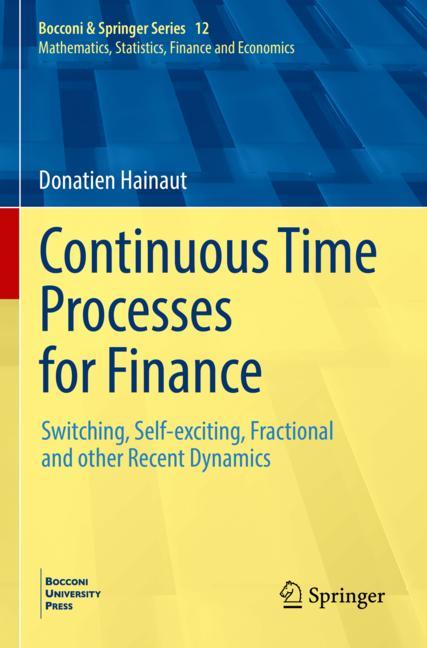
Continuous Time Processes for Finance
☆☆☆☆☆
(0 reviews)
Lowest price (incl. delivery)
112,99 USD
Typical price1 954,02 PLN
Lowest (90 days)83,99 PLN
Offers6
Last updatedför 1 vecka sedan
Price history (90 days)
Full history
2026-08-08
2026-08-15
| Uppdaterad | Pris |
|---|---|
| 2026-08-08 | 83,99 |
| 2026-08-15 | 83,99 |
| Säljare | Product price | Delivery | Totalt | Tillgänglighet | Updated | |
|---|---|---|---|---|---|---|
| SP SpringerNatureLink Shop INT | 97,99 USD | 15,00 USD | 112,99 USD | Tillgänglig | för 5 dagar sedan | View offer |
| SP SpringerNatureLink Shop INT | 111,99 USD | free | 111,99 USD | Tillgänglig | för 5 dagar sedan | View offer |
| SP SpringerNatureLink Shop INT | 111,99 USD | 15,00 USD | 126,99 USD | Tillgänglig | för 5 dagar sedan | View offer |
| SP SpringerNatureLink Shop INT | 115,85 EUR | 29,00 EUR | 144,85 EUR | Tillgänglig | för 5 dagar sedan | View offer |
| SP SpringerNatureLink Shop INT | 20 019,00 JPY | free | 20 019,00 JPY | Tillgänglig | för 5 dagar sedan | View offer |
| SP Springer Nature Author | 20 019,00 JPY | free | 20 019,00 JPY | Tillgänglig | för 1 vecka sedan | View offer |
Priser och tillgänglighet kan ändras. Senast uppdaterad: 08.08.2026 22:34.
0,0
☆☆☆☆☆
0 reviews
5★
0%
4★
0%
3★
0%
2★
0%
1★
0%
Product reviews
No reviews yet — be the first!
This book explores recent topics in quantitative finance with an emphasis on applications and calibration to time-series. This last aspect is often neglected in the existing mathematical finance literature while it is crucial for risk management. The first part of this book focuses on switching regime processes that allow to model economic cycles in financial markets. After a presentation of their mathematical features and applications to stocks and interest rates, the estimation with the Hamilton filter and Markov Chain Monte-Carlo algorithm (MCMC) is detailed. A second part focuses on self-excited processes for modeling the clustering of shocks in financial markets. These processes recently receive a lot of attention from researchers and we focus here on its econometric estimation and its simulation. A chapter is dedicated to estimation of stochastic volatility models. Two chapters are dedicated to the fractional Brownian motion and Gaussian fields. After a summary of their features, we present applications for stock and interest rate modeling. Two chapters focuses on sub-diffusions that allows to replicate illiquidity in financial markets. This book targets undergraduate students who have followed a first course of stochastic finance and practitioners as quantitative analyst or actuaries working in risk management.
Similar products
 50 Years of Philosophy and Medicine
from $107.30
50 Years of Philosophy and Medicine
from $107.30
 Understanding Cybersecurity Law and Digital Privacy
from $122.63
Understanding Cybersecurity Law and Digital Privacy
from $122.63
 Decisions in International Trade and Logistics
from $122.63
Decisions in International Trade and Logistics
from $122.63
 Advances in Economic Measurement
from $122.63
Advances in Economic Measurement
from $122.63
 Nanomaterials
from $137.96
Nanomaterials
from $137.96
 Sustainable Scaffolds-based Strategies in Tissue Engineering and Regenerative Medicine
from $162.87
Sustainable Scaffolds-based Strategies in Tissue Engineering and Regenerative Medicine
from $162.87
 Narratives in Educational Research
from $162.87
Narratives in Educational Research
from $162.87
 Environmental Biology of the Young Chinese Sturgeon
from $210.78
Environmental Biology of the Young Chinese Sturgeon
from $210.78