
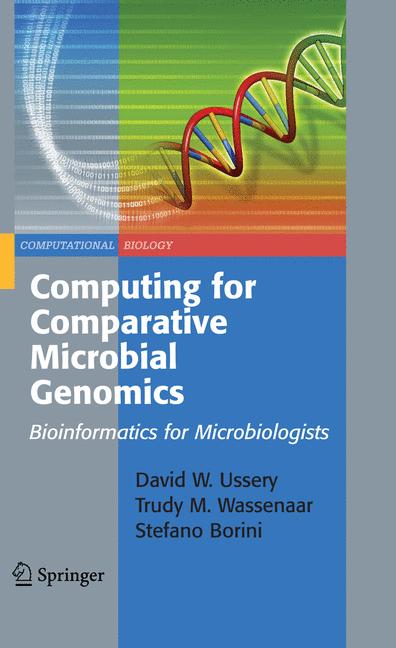
Computing for Comparative Microbial Genomics
☆☆☆☆☆
(0 reviews)
Lowest price (incl. delivery)
7 149,00 JPY
Typical price445,04 PLN
Lowest (90 days)44,99 PLN
Offers7
Last updatedför 1 vecka sedan
Price history (90 days)
Full history
2026-08-08
2026-08-15
| Uppdaterad | Pris |
|---|---|
| 2026-08-08 | 44,99 |
| 2026-08-14 | 44,99 |
| 2026-08-15 | 51,99 |
| Säljare | Product price | Delivery | Totalt | Tillgänglighet | Updated | |
|---|---|---|---|---|---|---|
| SP SpringerNatureLink Shop INT | 7 149,00 JPY | free | 7 149,00 JPY | Tillgänglig | för 17 timmar sedan | View offer |
| SP Springer Nature Author | 7 149,00 JPY | free | 7 149,00 JPY | Tillgänglig | för 1 vecka sedan | View offer |
| SP SpringerNatureLink Shop INT | 49,99 USD | free | 49,99 USD | Tillgänglig | för 1 dag sedan | View offer |
| SP SpringerNatureLink Shop INT | 49,99 USD | 15,00 USD | 64,99 USD | Tillgänglig | för 1 dag sedan | View offer |
| SP SpringerNatureLink Shop INT | 54,99 USD | 15,00 USD | 69,99 USD | Tillgänglig | för 1 dag sedan | View offer |
| SP SpringerNatureLink Shop INT | 54,99 USD | free | 54,99 USD | Tillgänglig | för 1 dag sedan | View offer |
| SP SpringerNatureLink Shop INT | 59,00 EUR | 29,00 EUR | 88,00 EUR | Tillgänglig | för 1 dag sedan | View offer |
Priser och tillgänglighet kan ändras. Senast uppdaterad: 08.08.2026 23:12.
0,0
☆☆☆☆☆
0 reviews
5★
0%
4★
0%
3★
0%
2★
0%
1★
0%
Product reviews
No reviews yet — be the first!
Overview and Goals This book describes how to visualize and compare bacterial genomes. Sequencing technologies are becoming so inexpensive that soon going for a cup of coffee will be more expensive than sequencing a bacterial genome. Thus, there is a very real and pressing need for high-throughput computational methods to compare hundreds and thousands of bacterial genomes. It is a long road from molecular biology to systems biology, and in a sense this text can be thought of as a path bridging these ? elds. The goal of this book is to p- vide a coherent set of tools and a methodological framework for starting with raw DNA sequences and producing fully annotated genome sequences, and then using these to build up and test models about groups of interacting organisms within an environment or ecological niche. Organization and Features The text is divided into four main parts: Introduction, Comparative Genomics, Transcriptomics and Proteomics, and ? nally Microbial Communities. The ? rst ? ve chapters are introductions of various sorts. Each of these chapters represents an introduction to a speci? c scienti? c ? eld, to bring all readers up to the same basic level before proceeding on to the methods of comparing genomes. First, a brief overview of molecular biology and of the concept of sequences as biological inf- mation are given.
Similar products
 50 Years of Philosophy and Medicine
from $107.30
50 Years of Philosophy and Medicine
from $107.30
 Understanding Cybersecurity Law and Digital Privacy
from $122.63
Understanding Cybersecurity Law and Digital Privacy
from $122.63
 Decisions in International Trade and Logistics
from $122.63
Decisions in International Trade and Logistics
from $122.63
 Advances in Economic Measurement
from $122.63
Advances in Economic Measurement
from $122.63
 Nanomaterials
from $137.96
Nanomaterials
from $137.96
 Sustainable Scaffolds-based Strategies in Tissue Engineering and Regenerative Medicine
from $162.87
Sustainable Scaffolds-based Strategies in Tissue Engineering and Regenerative Medicine
from $162.87
 Narratives in Educational Research
from $162.87
Narratives in Educational Research
from $162.87
 Environmental Biology of the Young Chinese Sturgeon
from $210.78
Environmental Biology of the Young Chinese Sturgeon
from $210.78