
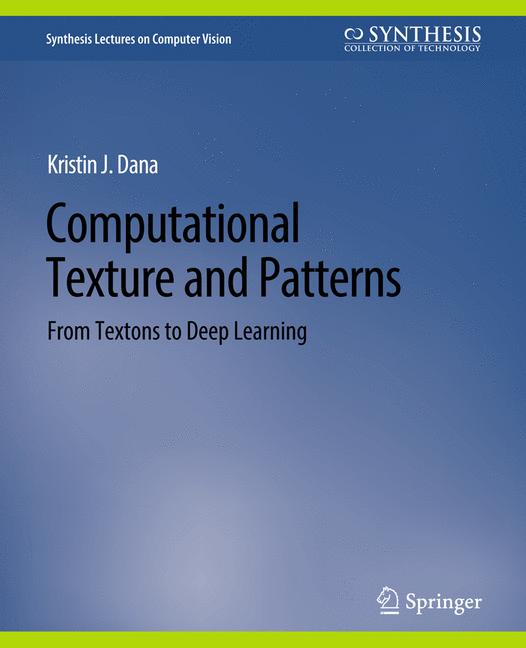
Computational Texture and Patterns
☆☆☆☆☆
(0 reviews)
Lowest price (incl. delivery)
56,01 AUD
Typical price47,32 PLN
Lowest (90 days)25,04 PLN
Offers4
Last updatedför 1 vecka sedan
Price history (90 days)
Full history
2026-08-07
2026-08-15
| Uppdaterad | Pris |
|---|---|
| 2026-08-07 | 25,04 |
| 2026-08-08 | 27,01 |
| 2026-08-15 | 57,19 |
| Säljare | Product price | Delivery | Totalt | Tillgänglighet | Updated | |
|---|---|---|---|---|---|---|
| VI VitalSource | 27,01 AUD | 29,00 AUD | 56,01 AUD | Tillgänglig | för 1 vecka sedan | View offer |
| SP SpringerNatureLink Shop INT | 7 864,00 JPY | 15,00 JPY | 7 879,00 JPY | Tillgänglig | för 14 timmar sedan | View offer |
| SP SpringerNatureLink Shop INT | 65,00 EUR | 19,00 EUR | 84,00 EUR | Tillgänglig | för 20 timmar sedan | View offer |
| SP Springer Nature Author | 65,00 EUR | 25,00 EUR | 90,00 EUR | Tillgänglig | för 1 vecka sedan | View offer |
Priser och tillgänglighet kan ändras. Senast uppdaterad: 08.08.2026 21:10.
EAN
9783031006951
Springer Nature
0,0
☆☆☆☆☆
0 reviews
5★
0%
4★
0%
3★
0%
2★
0%
1★
0%
Product reviews
No reviews yet — be the first!
Visual pattern analysis is a fundamental tool in mining data for knowledge. Computational representations for patterns and texture allow us to summarize, store, compare, and label in order to learn about the physical world. Our ability to capture visual imagery with cameras and sensors has resulted in vast amounts of raw data, but using this information effectively in a task-specific manner requires sophisticated computational representations. We enumerate specific desirable traits for these representations: (1) intraclass invariance—to support recognition; (2) illumination and geometric invariance for robustness to imaging conditions; (3) support for prediction and synthesis to use the model to infer continuation of the pattern; (4) support for change detection to detect anomalies and perturbations; and (5) support for physics-based interpretation to infer system properties from appearance. In recent years, computer vision has undergone a metamorphosis with classic algorithms adaptingto new trends in deep learning. This text provides a tour of algorithm evolution including pattern recognition, segmentation and synthesis. We consider the general relevance and prominence of visual pattern analysis and applications that rely on computational models.