
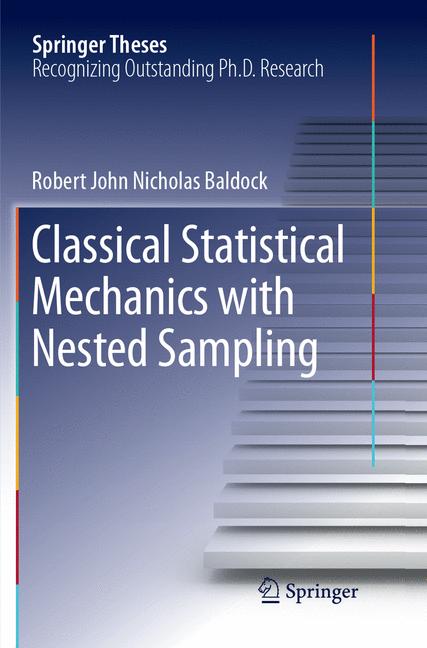
Classical Statistical Mechanics with Nested Sampling
☆☆☆☆☆
(0 reviews)
Lowest price (incl. delivery)
14 299,00 JPY
Typical price1 089,73 PLN
Lowest (90 days)71,50 PLN
Offers6
Last updatedför 1 vecka sedan
Price history (90 days)
Full history
2026-08-08
2026-08-15
| Uppdaterad | Pris |
|---|---|
| 2026-08-08 | 84,99 |
| 2026-08-15 | 71,50 |
| Säljare | Product price | Delivery | Totalt | Tillgänglighet | Updated | |
|---|---|---|---|---|---|---|
| SP SpringerNatureLink Shop INT | 14 299,00 JPY | free | 14 299,00 JPY | Tillgänglig | för 1 vecka sedan | View offer |
| SP Springer Nature Author | 14 299,00 JPY | 19,00 JPY | 14 318,00 JPY | Tillgänglig | för 1 vecka sedan | View offer |
| SP SpringerNatureLink Shop INT | 99,99 USD | free | 99,99 USD | Tillgänglig | för 1 vecka sedan | View offer |
| SP SpringerNatureLink Shop INT | 109,99 USD | 25,00 USD | 134,99 USD | Tillgänglig | för 1 vecka sedan | View offer |
| SP SpringerNatureLink Shop INT | 109,99 USD | 29,00 USD | 138,99 USD | Tillgänglig | för 1 vecka sedan | View offer |
| SP SpringerNatureLink Shop INT | 118,00 EUR | free | 118,00 EUR | Tillgänglig | för 1 vecka sedan | View offer |
Priser och tillgänglighet kan ändras. Senast uppdaterad: 08.08.2026 23:20.
0,0
☆☆☆☆☆
0 reviews
5★
0%
4★
0%
3★
0%
2★
0%
1★
0%
Product reviews
No reviews yet — be the first!
This thesis develops a nested sampling algorithm into a black box tool for directly calculating the partition function, and thus the complete phase diagram of a material, from the interatomic potential energy function. It represents a significant step forward in our ability to accurately describe the finite temperature properties of materials. In principle, the macroscopic phases of matter are related to the microscopic interactions of atoms by statistical mechanics and the partition function. In practice, direct calculation of the partition function has proved infeasible for realistic models of atomic interactions, even with modern atomistic simulation methods. The thesis also shows how the output of nested sampling calculations can be processed to calculate the complete PVT (pressure–volume–temperature) equation of state for a material, and applies the nested sampling algorithm to calculate the pressure–temperature phase diagrams of aluminium and a model binary alloy.
Similar products
 50 Years of Philosophy and Medicine
from $107.30
50 Years of Philosophy and Medicine
from $107.30
 Understanding Cybersecurity Law and Digital Privacy
from $122.63
Understanding Cybersecurity Law and Digital Privacy
from $122.63
 Decisions in International Trade and Logistics
from $122.63
Decisions in International Trade and Logistics
from $122.63
 Advances in Economic Measurement
from $122.63
Advances in Economic Measurement
from $122.63
 Nanomaterials
from $137.96
Nanomaterials
from $137.96
 Sustainable Scaffolds-based Strategies in Tissue Engineering and Regenerative Medicine
from $162.87
Sustainable Scaffolds-based Strategies in Tissue Engineering and Regenerative Medicine
from $162.87
 Narratives in Educational Research
from $162.87
Narratives in Educational Research
from $162.87
 Environmental Biology of the Young Chinese Sturgeon
from $210.78
Environmental Biology of the Young Chinese Sturgeon
from $210.78