
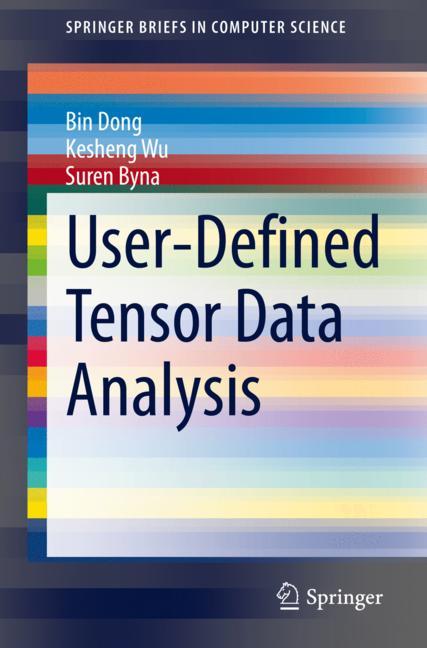
User-Defined Tensor Data Analysis
☆☆☆☆☆
(0 reviews)
Lowest price (incl. delivery)
56,50 EUR
Typical price51,84 PLN
Lowest (90 days)50,28 PLN
Offers1
Last updatedpred 2 dňami
| Predajca | Product price | Delivery | Spolu | Dostupnosť | Updated | |
|---|---|---|---|---|---|---|
| SP Springer Nature Author | 56,50 EUR | free | 56,50 EUR | Dostupné | pred 2 dňami | View offer |
Ceny a dostupnosť sa môžu zmeniť. Naposledy aktualizované: 08.08.2026 20:59.
EAN
9783030707507
Springer Nature
0,0
☆☆☆☆☆
0 reviews
5★
0%
4★
0%
3★
0%
2★
0%
1★
0%
Product reviews
No reviews yet — be the first!
The SpringerBrief introduces FasTensor, a powerful parallel data programming model developed for big data applications. This book also provides a user's guide for installing and using FasTensor. FasTensor enables users to easily express many data analysis operations, which may come from neural networks, scientific computing, or queries from traditional database management systems (DBMS). FasTensor frees users from all underlying and tedious data management tasks, such as data partitioning, communication, and parallel execution. This SpringerBrief gives a high-level overview of the state-of-the-art in parallel data programming model and a motivation for the design of FasTensor. It illustrates the FasTensor application programming interface (API) with an abundance of examples and two real use cases from cutting edge scientific applications. FasTensor can achieve multiple orders of magnitude speedup over Spark and other peer systems in executing big data analysis operations. FasTensor makes programming for data analysis operations at large scale on supercomputers as productively and efficiently as possible. A complete reference of FasTensor includes its theoretical foundations, C++ implementation, and usage in applications. Scientists in domains such as physical and geosciences, who analyze large amounts of data will want to purchase this SpringerBrief. Data engineers who design and develop data analysis software and data scientists, and who use Spark or TensorFlow to perform data analyses, such as training a deep neural network will also find this SpringerBrief useful as a reference tool.
Similar products
 Gamma Knife Neurosurgery in the Management of Intracranial Disorders
from $210.78
Gamma Knife Neurosurgery in the Management of Intracranial Disorders
from $210.78
 SDGs in Construction Economics and Organization
from $210.78
SDGs in Construction Economics and Organization
from $210.78
 Emerging Therapies in Neurorehabilitation III
from $210.78
Emerging Therapies in Neurorehabilitation III
from $210.78
 Ground Improvement Techniques
from $220.36
Ground Improvement Techniques
from $220.36
 Anomaly Detection in Video Surveillance
from $220.36
Anomaly Detection in Video Surveillance
from $220.36
 Mechanism and Machine Science
from $287.42
Mechanism and Machine Science
from $287.42
 Protein-Protein Interactions as New Drug Targets
from $287.42
Protein-Protein Interactions as New Drug Targets
from $287.42
 Proceedings of the 7th International Conference of Transportation Research Group of India (CTRG 2023
from $287.42
Proceedings of the 7th International Conference of Transportation Research Group of India (CTRG 2023
from $287.42