
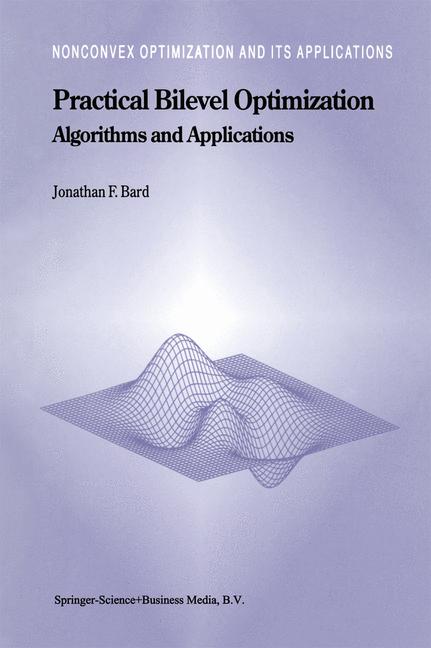
Practical Bilevel Optimization
☆☆☆☆☆
(0 reviews)
Lowest price (incl. delivery)
328,99 USD
Typical price289,99 PLN
Lowest (90 days)249,99 PLN
Offers6
Last updatedpred 1 dňom
Price history (90 days)
Full history
2026-08-08
2026-08-15
| Aktualizované | Cena |
|---|---|
| 2026-08-08 | 249,99 |
| 2026-08-15 | 329,99 |
| Predajca | Product price | Delivery | Spolu | Dostupnosť | Updated | |
|---|---|---|---|---|---|---|
| SP SpringerNatureLink Shop INT | 299,99 USD | 29,00 USD | 328,99 USD | Dostupné | pred 1 dňom | View offer |
| SP SpringerNatureLink Shop INT | 299,99 USD | free | 299,99 USD | Dostupné | pred 1 dňom | View offer |
| SP Springer Nature Author | 249,99 GBP | 19,00 GBP | 268,99 GBP | Dostupné | pred 1 týždňom | View offer |
| SP SpringerNatureLink Shop INT | 329,99 USD | free | 329,99 USD | Dostupné | pred 1 dňom | View offer |
| SP SpringerNatureLink Shop INT | 329,99 USD | free | 329,99 USD | Dostupné | pred 1 dňom | View offer |
| SP SpringerNatureLink Shop INT | 329,99 EUR | free | 329,99 EUR | Dostupné | pred 1 dňom | View offer |
Ceny a dostupnosť sa môžu zmeniť. Naposledy aktualizované: 15.08.2026 07:33.
0,0
☆☆☆☆☆
0 reviews
5★
0%
4★
0%
3★
0%
2★
0%
1★
0%
Product reviews
No reviews yet — be the first!
The use of optimization techniques has become integral to the design and analysis of most industrial and socio-economic systems. Great strides have been made recently in the solution of large-scale problems arising in such areas as production planning, airline scheduling, government regulation, and engineering design, to name a few. Analysts have found, however, that standard mathematical programming models are often inadequate in these situations because more than a single objective function and a single decision maker are involved. Multiple objective programming deals with the extension of optimization techniques to account for several objective functions, while game theory deals with the inter-personal dynamics surrounding conflict. Bilevel programming, the focus of this book, is in a narrow sense the combination of the two. It addresses the problern in which two decision makers, each with their individual objectives, act and react in a noncooperative, sequential manner. The actions of one affect the choices and payoffs available to the other but neither player can completely dominate the other in the traditional sense.
Similar products
 Gamma Knife Neurosurgery in the Management of Intracranial Disorders
from $210.78
Gamma Knife Neurosurgery in the Management of Intracranial Disorders
from $210.78
 SDGs in Construction Economics and Organization
from $210.78
SDGs in Construction Economics and Organization
from $210.78
 Emerging Therapies in Neurorehabilitation III
from $210.78
Emerging Therapies in Neurorehabilitation III
from $210.78
 Ground Improvement Techniques
from $220.36
Ground Improvement Techniques
from $220.36
 Anomaly Detection in Video Surveillance
from $220.36
Anomaly Detection in Video Surveillance
from $220.36
 Mechanism and Machine Science
from $287.42
Mechanism and Machine Science
from $287.42
 Protein-Protein Interactions as New Drug Targets
from $287.42
Protein-Protein Interactions as New Drug Targets
from $287.42
 Proceedings of the 7th International Conference of Transportation Research Group of India (CTRG 2023
from $287.42
Proceedings of the 7th International Conference of Transportation Research Group of India (CTRG 2023
from $287.42