
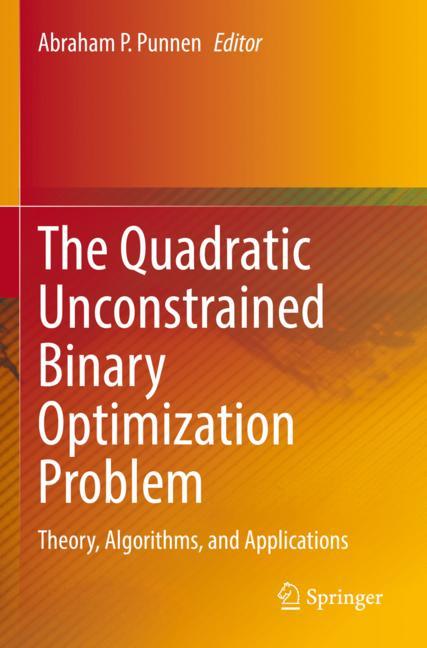
The Quadratic Unconstrained Binary Optimization Problem
☆☆☆☆☆
(0 reviews)
Lowest price (incl. delivery)
148,75 EUR
Typical price2 729,49 PLN
Lowest (90 days)148,75 PLN
Offers3
Last updated6 дней назад
Price history (90 days)
Full history
2026-08-08
2026-08-15
| Обновлено | Цена |
|---|---|
| 2026-08-08 | 148,75 |
| 2026-08-15 | 148,75 |
| Продавец | Product price | Delivery | Всего | Наличие | Updated | |
|---|---|---|---|---|---|---|
| SP SpringerNatureLink Shop INT | 148,75 EUR | free | 148,75 EUR | Доступно | 4 часа назад | View offer |
| SP SpringerNatureLink Shop INT | 25 739,00 JPY | 29,00 JPY | 25 768,00 JPY | Доступно | 3 часа назад | View offer |
| SP Springer Nature Author | 25 739,00 JPY | 25,00 JPY | 25 764,00 JPY | Доступно | 6 дней назад | View offer |
Цены и наличие могут меняться. Последнее обновление: 08.08.2026 22:50.
EAN
9783031045226
Springer Nature
0,0
☆☆☆☆☆
0 reviews
5★
0%
4★
0%
3★
0%
2★
0%
1★
0%
Product reviews
No reviews yet — be the first!
The quadratic binary optimization problem (QUBO) is a versatile combinatorial optimization model with a variety of applications and rich theoretical properties. Application areas of the model include finance, cluster analysis, traffic management, machine scheduling, VLSI physical design, physics, quantum computing, engineering, and medicine. In addition, various mathematical optimization models can be reformulated as a QUBO, including the resource constrained assignment problem, set partitioning problem, maximum cut problem, quadratic assignment problem, the bipartite unconstrained binary optimization problem, among others. This book presents a systematic development of theory, algorithms, and applications of QUBO. It offers a comprehensive treatment of QUBO from various viewpoints, including a historical introduction along with an in-depth discussion of applications modelling, complexity and polynomially solvable special cases, exact and heuristic algorithms, analysis of approximation algorithms, metaheuristics, polyhedral structure, probabilistic analysis, persistencies, and related topics. Available software for solving QUBO is also introduced, including public domain, commercial, as well as quantum computing based codes.
Similar products
 50 Years of Philosophy and Medicine
from $107.30
50 Years of Philosophy and Medicine
from $107.30
 Understanding Cybersecurity Law and Digital Privacy
from $122.63
Understanding Cybersecurity Law and Digital Privacy
from $122.63
 Decisions in International Trade and Logistics
from $122.63
Decisions in International Trade and Logistics
from $122.63
 Advances in Economic Measurement
from $122.63
Advances in Economic Measurement
from $122.63
 Nanomaterials
from $137.96
Nanomaterials
from $137.96
 Sustainable Scaffolds-based Strategies in Tissue Engineering and Regenerative Medicine
from $162.87
Sustainable Scaffolds-based Strategies in Tissue Engineering and Regenerative Medicine
from $162.87
 Narratives in Educational Research
from $162.87
Narratives in Educational Research
from $162.87
 Environmental Biology of the Young Chinese Sturgeon
from $210.78
Environmental Biology of the Young Chinese Sturgeon
from $210.78