
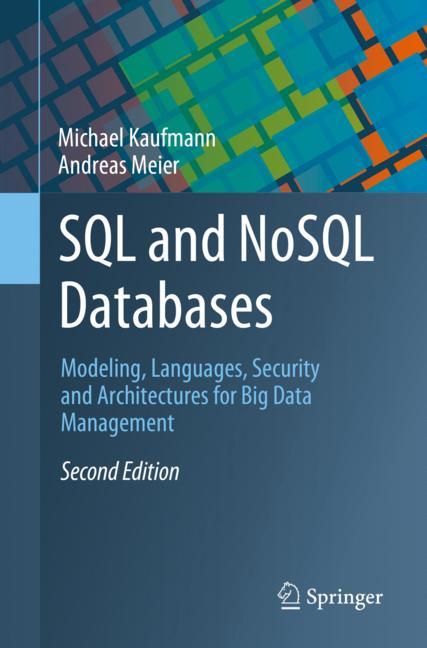
SQL and NoSQL Databases
☆☆☆☆☆
(0 reviews)
Lowest price (incl. delivery)
58,05 EUR
Typical price43,05 PLN
Lowest (90 days)43,05 PLN
Offers3
Last updated11 минут назад
| Продавец | Product price | Delivery | Всего | Наличие | Updated | |
|---|---|---|---|---|---|---|
| SP SpringerNatureLink Shop INT | 43,05 EUR | 15,00 EUR | 58,05 EUR | Доступно | 6 часов назад | View offer |
| SP Springer Nature Author | 43,05 EUR | free | 43,05 EUR | Доступно | 6 дней назад | View offer |
| SP SpringerNatureLink Shop INT | 7 435,00 JPY | free | 7 435,00 JPY | Доступно | 11 минут назад | View offer |
Цены и наличие могут меняться. Последнее обновление: 15.08.2026 07:52.
EAN
9783031279089
Springer Nature
0,0
☆☆☆☆☆
0 reviews
5★
0%
4★
0%
3★
0%
2★
0%
1★
0%
Product reviews
No reviews yet — be the first!
This textbook offers a comprehensive introduction to relational (SQL) and non-relational (NoSQL) databases. The authors thoroughly review the current state of database tools and techniques and examine upcoming innovations. In the first five chapters, the authors analyze in detail the management, modeling, languages, security, and architecture of relational databases, graph databases, and document databases. Moreover, an overview of other SQL- and NoSQL-based database approaches is provided. In addition to classic concepts such as the entity and relationship model and its mapping in SQL database schemas, query languages or transaction management, other aspects for NoSQL databases such as non-relational data models, document and graph query languages (MQL, Cypher), the Map/Reduce procedure, distribution options (sharding, replication) or the CAP theorem (Consistency, Availability, Partition Tolerance) are explained. This 2nd English edition offers a new in-depth introduction to document databases with a method for modeling document structures, an overview of the document-oriented MongoDB query language MQL as well as security and architecture aspects. The topic of database security is newly introduced as a separate chapter and analyzed in detail with regard to data protection, integrity, and transactions. Texts on data management, database programming, and data warehousing and data lakes have been updated. In addition, the book now explains the concepts of JSON, JSON schema, BSON, index-free neighborhood, cloud databases, search engines and time series databases. The book includes more than 100 tables, examples and illustrations, and each chapter offers a list of resources for further reading. It conveys an in-depth comparison of relational and non-relational approaches and shows how to undertake development for big data applications. This way, it benefits students and practitioners working across the broad field of data science and applied information technology.
Similar products
 Multicultural British Screen Comedy
from $91.97
Multicultural British Screen Comedy
from $91.97
 BRICS and the Changing World Order
from $91.97
BRICS and the Changing World Order
from $91.97
 Becoming Anne Lister
from $91.97
Becoming Anne Lister
from $91.97
 Institutional Racism in Psychiatry and Clinical Psychology
from $91.97
Institutional Racism in Psychiatry and Clinical Psychology
from $91.97
 Nonlinear Approximation Theory
from $91.97
Nonlinear Approximation Theory
from $91.97
 Rethinking Democracy in Social Work
from $91.97
Rethinking Democracy in Social Work
from $91.97
 Diabetes and Peripheral Vascular Disease
from $91.97
Diabetes and Peripheral Vascular Disease
from $91.97
 Ethnographic Peace Research
from $91.97
Ethnographic Peace Research
from $91.97