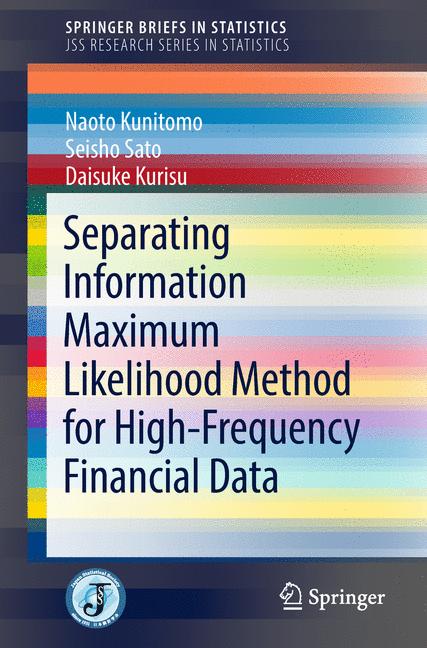
Separating Information Maximum Likelihood Method for High-Frequency Financial Data
☆☆☆☆☆
(0 reviews)
EAN: 9784431559306
Lowest price (incl. delivery)
6 316,00 JPY
- Offers
- 2
- Last updated
- 3 месяца назад
| Продавец | Product price | Delivery | Всего | Наличие | Updated | |
|---|---|---|---|---|---|---|
| SpringerNatureLink Shop INT | Product price 6 291,00 JPY | Delivery 25,00 JPY | Всего 6 316,00 JPY | Наличие Доступно | Updated 3 месяца назад | View offer |
| Springer Nature Author | Product price 6 291,00 JPY ▲ 13 576,1% | Delivery free | Всего 6 291,00 JPY | Наличие Доступно | Updated 3 месяца назад | View offer |
Цены и наличие могут меняться. Последнее обновление: 08.08.2026 23:10.
EAN
9784431559306
Springer Nature
0,0
☆☆☆☆☆
0 reviews
5★
0%
4★
0%
3★
0%
2★
0%
1★
0%
Product reviews
No reviews yet — be the first!
This book presents a systematic explanation of the SIML (Separating Information Maximum Likelihood) method, a new approach to financial econometrics. Considerable interest has been given to the estimation problem of integrated volatility and covariance by using high-frequency financial data. Although several new statistical estimation procedures have been proposed, each method has some desirable properties along with some shortcomings that call for improvement. For estimating integrated volatility, covariance, and the related statistics by using high-frequency financial data, the SIML method has been developed by Kunitomo and Sato to deal with possible micro-market noises. The authors show that the SIML estimator has reasonable finite sample properties as well as asymptotic properties in the standard cases. It is also shown that the SIML estimator has robust properties in the sense that it is consistent and asymptotically normal in the stable convergence sense when there are micro-market noises, micro-market (non-linear) adjustments, and round-off errors with the underlying (continuous time) stochastic process. Simulation results are reported in a systematic way as are some applications of the SIML method to the Nikkei-225 index, derived from the major stock index in Japan and the Japanese financial sector.
Similar products