
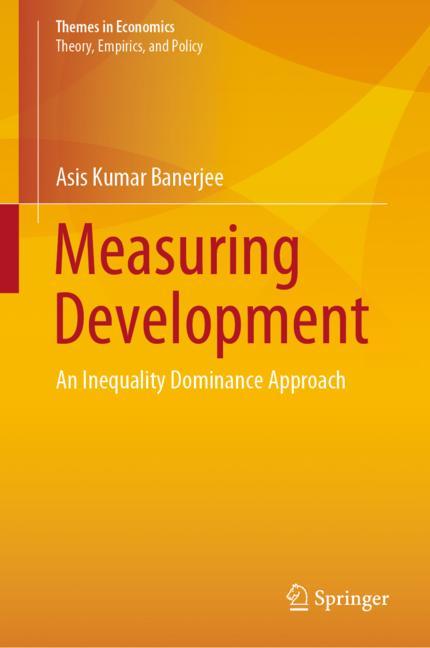
Measuring Development
☆☆☆☆☆
(0 reviews)
Lowest price (incl. delivery)
15 729,00 JPY
Typical price799,37 PLN
Lowest (90 days)89,00 PLN
Offers2
Last updated17 часов назад
| Продавец | Product price | Delivery | Всего | Наличие | Updated | |
|---|---|---|---|---|---|---|
| SP Springer Nature Author | 15 729,00 JPY | free | 15 729,00 JPY | Доступно | 16 часов назад | View offer |
| SP SpringerNatureLink Shop INT | 114,39 EUR | 15,00 EUR | 129,39 EUR | Доступно | 1 день назад | View offer |
Цены и наличие могут меняться. Последнее обновление: 08.08.2026 22:11.
0,0
☆☆☆☆☆
0 reviews
5★
0%
4★
0%
3★
0%
2★
0%
1★
0%
Product reviews
No reviews yet — be the first!
This book discusses how to measure the level of development of an economy, particularly, the task of ranking economies in terms of their development. In this context, development is defined as an increase in people’s level of wellbeing. The book emphasises that wellbeing is a multidimensional concept, and that it is important to ask how equitably the fruits of development are distributed, and as such it focuses on multidimensional, inequality-sensitive development ranking. Rather than using various specific development indices, which would lead to different development rankings for a country, the book proposes a dominance approach, which formulates conditions under which two economies can be ranked unambiguously, making it valid for all reasonable development indices. With the help of illustrative examples using real-world data, it demonstrates that such unambiguous rankings are possible, and that the proposed approach can be used to complement traditional approaches. An invaluable resource for researchers working in the field of development, the book will also appeal to practitioners engaged in measuring development. An excerpt from the book's Foreword: "[This book] is a comprehensive and valuable contribution to the literature on the measurement of inequality and the use of such measurement in the assessment of social welfare. I believe that it will be of much interest to researchers working on measures of inequality and social welfare as well as advanced graduate students who are looking for a solid introduction to this important area of normative economics." - Prof. Prasanta K. Pattanaik, University of California, Riverside, California, U.S.A.
Similar products
 Patient Safety Coaching
from $91.97
Patient Safety Coaching
from $91.97
 Ethnography and Diversity
from $69.30
Ethnography and Diversity
from $69.30
 Smart Villages
from $91.97
Smart Villages
from $91.97
 Nuclear Non-Proliferation in International Law - Volume VI
from $91.97
Nuclear Non-Proliferation in International Law - Volume VI
from $91.97
 The Price of Freedom
from $91.97
The Price of Freedom
from $91.97
 Eco-Social Policy in the OECD and the World Bank
from $91.97
Eco-Social Policy in the OECD and the World Bank
from $91.97
 Special Topics in Policing
from $122.58
Special Topics in Policing
from $122.58
 Music from the Heart
from $91.97
Music from the Heart
from $91.97