
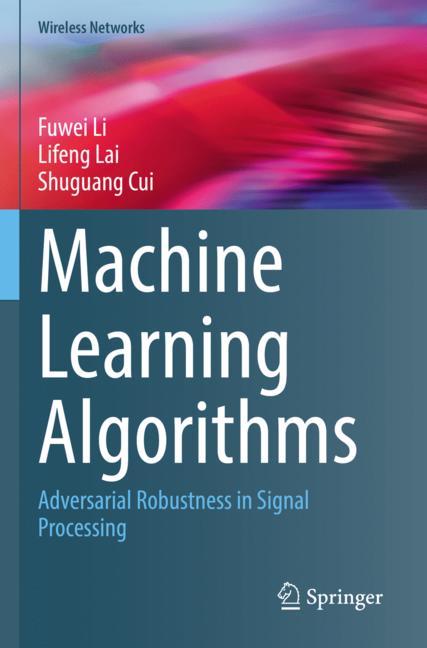
Machine Learning Algorithms
☆☆☆☆☆
(0 reviews)
Lowest price (incl. delivery)
99,99 USD
Typical price853,74 PLN
Lowest (90 days)74,89 PLN
Offers2
Last updated9 часов назад
| Продавец | Product price | Delivery | Всего | Наличие | Updated | |
|---|---|---|---|---|---|---|
| SP SpringerNatureLink Shop INT | 99,99 USD | free | 99,99 USD | Доступно | 17 часов назад | View offer |
| SP Springer Nature Author | 20 019,00 JPY | 25,00 JPY | 20 044,00 JPY | Доступно | 8 часов назад | View offer |
Цены и наличие могут меняться. Последнее обновление: 08.08.2026 22:34.
0,0
☆☆☆☆☆
0 reviews
5★
0%
4★
0%
3★
0%
2★
0%
1★
0%
Product reviews
No reviews yet — be the first!
This book demonstrates the optimal adversarial attacks against several important signal processing algorithms. Through presenting the optimal attacks in wireless sensor networks, array signal processing, principal component analysis, etc, the authors reveal the robustness of the signal processing algorithms against adversarial attacks. Since data quality is crucial in signal processing, the adversary that can poison the data will be a significant threat to signal processing. Therefore, it is necessary and urgent to investigate the behavior of machine learning algorithms in signal processing under adversarial attacks. The authors in this book mainly examine the adversarial robustness of three commonly used machine learning algorithms in signal processing respectively: linear regression, LASSO-based feature selection, and principal component analysis (PCA). As to linear regression, the authors derive the optimal poisoning data sample and the optimal feature modifications, and also demonstrate the effectiveness of the attack against a wireless distributed learning system. The authors further extend the linear regression to LASSO-based feature selection and study the best strategy to mislead the learning system to select the wrong features. The authors find the optimal attack strategy by solving a bi-level optimization problem and also illustrate how this attack influences array signal processing and weather data analysis. In the end, the authors consider the adversarial robustness of the subspace learning problem. The authors examine the optimal modification strategy under the energy constraints to delude the PCA-based subspace learning algorithm. This book targets researchers working in machine learning, electronic information, and information theory as well as advanced-level students studying these subjects. R&D engineers who are working in machine learning, adversarial machine learning, robust machine learning, and technical consultants working on the security and robustness of machine learning are likely to purchase this book as a reference guide.
Similar products
 Patient Safety Coaching
from $91.97
Patient Safety Coaching
from $91.97
 Ethnography and Diversity
from $69.30
Ethnography and Diversity
from $69.30
 Smart Villages
from $91.97
Smart Villages
from $91.97
 Nuclear Non-Proliferation in International Law - Volume VI
from $91.97
Nuclear Non-Proliferation in International Law - Volume VI
from $91.97
 The Price of Freedom
from $91.97
The Price of Freedom
from $91.97
 Eco-Social Policy in the OECD and the World Bank
from $91.97
Eco-Social Policy in the OECD and the World Bank
from $91.97
 Special Topics in Policing
from $122.58
Special Topics in Policing
from $122.58
 Music from the Heart
from $91.97
Music from the Heart
from $91.97