
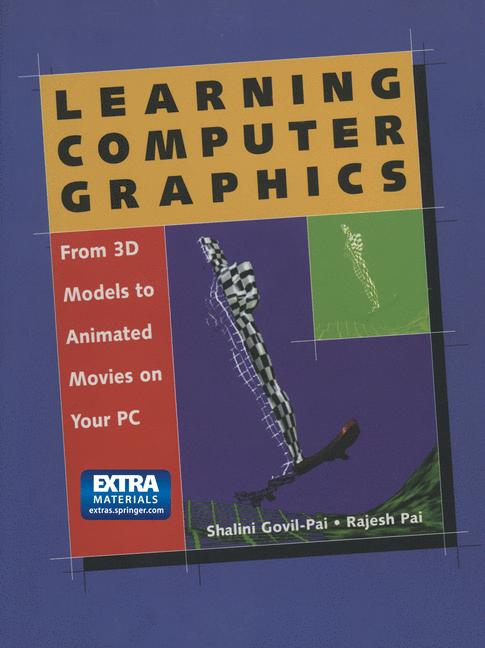
Learning Computer Graphics
☆☆☆☆☆
(0 reviews)
Lowest price (incl. delivery)
7 174,00 JPY
Typical price362,20 PLN
Lowest (90 days)49,99 PLN
Offers2
Last updated4 часа назад
| Продавец | Product price | Delivery | Всего | Наличие | Updated | |
|---|---|---|---|---|---|---|
| SP Springer Nature Author | 7 149,00 JPY | 25,00 JPY | 7 174,00 JPY | Доступно | 4 часа назад | View offer |
| SP SpringerNatureLink Shop INT | 59,00 EUR | free | 59,00 EUR | Доступно | 16 часов назад | View offer |
Цены и наличие могут меняться. Последнее обновление: 08.08.2026 23:11.
0,0
☆☆☆☆☆
0 reviews
5★
0%
4★
0%
3★
0%
2★
0%
1★
0%
Product reviews
No reviews yet — be the first!
• Modeling - creating objects in three-dimensional space. • Animation - assigning a time-varying geometry and behavior to the modeled object. • Rendering - creating a photorealistic image of the modeled object. • Image Manipulation - enhancing rendered images to produce desired special effects. This book is organized to give the reader a clear and concise over view of the above basic principles in computer graphics. New concepts introduced in a chapter are illustrated by hands-on projects using the software provided. The chapters are organized as described below: Chapter 1 providesanoverviewofcomputergraphics (CG) andhow it has evolved. It includes an introduction to computer graphics ter minology and definitions. Chapter 2 describes what modeling means in CG. The concept of wire frame models is elucidated. Basic models (sphere, cube, cylinder, cone, polygon) are covered and an insight into polygonal representa tions of other complex objects is also provided. The projects included in this chapter involve use of modeling concepts leamed in the chapter. Chapter 3 discusses animation in detail. Principles of frame ani mation and real time animation are explained. The reader is given the opportunity to animate the modeled objects from Chapter 2. Chapter 4 covers rendering of the wire frame objects created in Chapter 2. The fundamentals oflighting, shading, and texture mapping are discussed. The objects created in Chapter 2 are rendered by the user and the complete animation is seen in a rendered form.
Similar products
 Patient Safety Coaching
from $91.97
Patient Safety Coaching
from $91.97
 Ethnography and Diversity
from $69.30
Ethnography and Diversity
from $69.30
 Smart Villages
from $91.97
Smart Villages
from $91.97
 Nuclear Non-Proliferation in International Law - Volume VI
from $91.97
Nuclear Non-Proliferation in International Law - Volume VI
from $91.97
 The Price of Freedom
from $91.97
The Price of Freedom
from $91.97
 Eco-Social Policy in the OECD and the World Bank
from $91.97
Eco-Social Policy in the OECD and the World Bank
from $91.97
 Special Topics in Policing
from $122.58
Special Topics in Policing
from $122.58
 Music from the Heart
from $91.97
Music from the Heart
from $91.97