
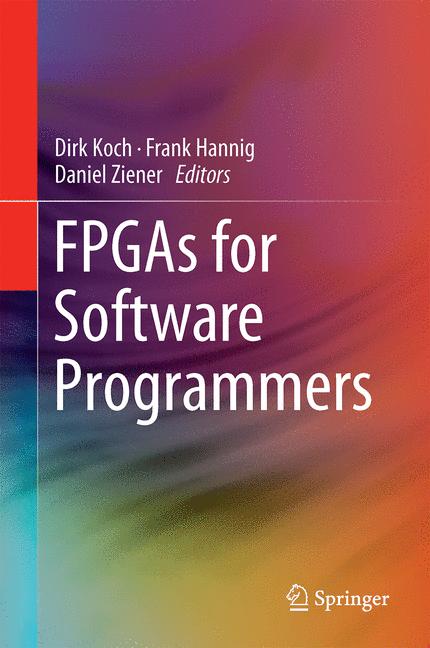
FPGAs for Software Programmers
☆☆☆☆☆
(0 reviews)
Lowest price (incl. delivery)
118,00 USD
Typical price1 110,52 PLN
Lowest (90 days)89,00 PLN
Offers3
Last updated15 часов назад
| Продавец | Product price | Delivery | Всего | Наличие | Updated | |
|---|---|---|---|---|---|---|
| SP SpringerNatureLink Shop INT | 89,00 USD | 29,00 USD | 118,00 USD | Доступно | 1 день назад | View offer |
| SP SpringerNatureLink Shop INT | 114,39 EUR | 15,00 EUR | 129,39 EUR | Доступно | 22 часа назад | View offer |
| SP Springer Nature Author | 21 449,00 JPY | 25,00 JPY | 21 474,00 JPY | Доступно | 14 часов назад | View offer |
Цены и наличие могут меняться. Последнее обновление: 08.08.2026 22:40.
0,0
☆☆☆☆☆
0 reviews
5★
0%
4★
0%
3★
0%
2★
0%
1★
0%
Product reviews
No reviews yet — be the first!
This book makes powerful Field Programmable Gate Array (FPGA) and reconfigurable technology accessible to software engineers by covering different state-of-the-art high-level synthesis approaches (e.g., OpenCL and several C-to-gates compilers). It introduces FPGA technology, its programming model, and how various applications can be implemented on FPGAs without going through low-level hardware design phases. Readers will get a realistic sense for problems that are suited for FPGAs and how to implement them from a software designer’s point of view. The authors demonstrate that FPGAs and their programming model reflect the needs of stream processing problems much better than traditional CPU or GPU architectures, making them well-suited for a wide variety of systems, from embedded systems performing sensor processing to large setups for Big Data number crunching. This book serves as an invaluable tool for software designers and FPGA design engineers who are interested in high design productivity through behavioural synthesis, domain-specific compilation, and FPGA overlays. Introduces FPGA technology to software developers by giving an overview of FPGA programming models and design tools, as well as various application examples; Provides a holistic analysis of the topic and enables developers to tackle the architectural needs for Big Data processing with FPGAs; Explains the reasons for the energy efficiency and performance benefits of FPGA processing; Provides a user-oriented approach and a sense for where and how to apply FPGA technology.
Similar products
 Patient Safety Coaching
from $91.97
Patient Safety Coaching
from $91.97
 Ethnography and Diversity
from $69.30
Ethnography and Diversity
from $69.30
 Smart Villages
from $91.97
Smart Villages
from $91.97
 Nuclear Non-Proliferation in International Law - Volume VI
from $91.97
Nuclear Non-Proliferation in International Law - Volume VI
from $91.97
 The Price of Freedom
from $91.97
The Price of Freedom
from $91.97
 Eco-Social Policy in the OECD and the World Bank
from $91.97
Eco-Social Policy in the OECD and the World Bank
from $91.97
 Special Topics in Policing
from $122.58
Special Topics in Policing
from $122.58
 Music from the Heart
from $91.97
Music from the Heart
from $91.97