
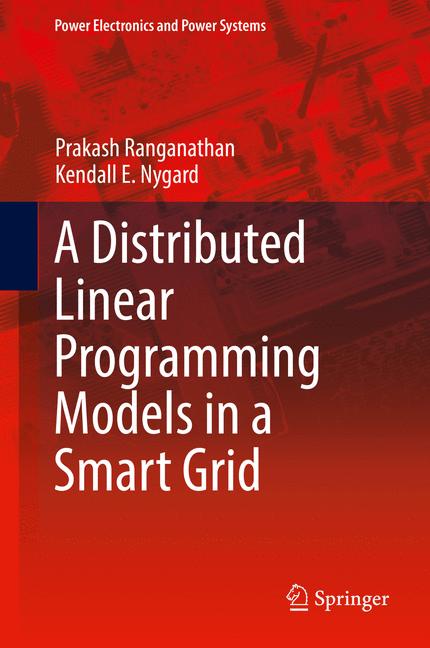
Distributed Linear Programming Models in a Smart Grid
☆☆☆☆☆
(0 reviews)
| Продавец | Product price | Delivery | Всего | Наличие | Updated | |
|---|---|---|---|---|---|---|
| SP Springer Nature Author | 14 871,00 JPY | free | 14 871,00 JPY | Доступно | 6 дней назад | View offer |
| SP SpringerNatureLink Shop INT | 122,50 EUR | free | 122,50 EUR | Доступно | 17 часов назад | View offer |
Цены и наличие могут меняться. Последнее обновление: 15.08.2026 04:39.
EAN
9783319526171
Springer Nature
0,0
☆☆☆☆☆
0 reviews
5★
0%
4★
0%
3★
0%
2★
0%
1★
0%
Product reviews
No reviews yet — be the first!
This book showcases the strengths of Linear Programming models for Cyber Physical Systems (CPS), such as the Smart Grids. Cyber-Physical Systems (CPS) consist of computational components interconnected by computer networks that monitor and control switched physical entities interconnected by physical infrastructures. A fundamental challenge in the design and analysis of CPS is the lack of understanding in formulating constraints for complex networks. We address this challenge by employing collection of Linear programming solvers that models the constraints of sub-systems and micro grids in a distributed fashion. The book can be treated as a useful resource to adaptively schedule resource transfers between nodes in a smart power grid. In addition, the feasibility conditions and constraints outlined in the book will enable in reaching optimal values that can help maintain the stability of both the computer network and the physical systems. It details the collection of optimization methods that are reliable for electric-utilities to use for resource scheduling, and optimizing their existing systems or sub-systems. The authors answer to key questions on ways to optimally allocate resources during outages, and contingency cases (e.g., line failures, and/or circuit breaker failures), how to design de-centralized methods for carrying out tasks using decomposition models; and how to quantify un-certainty and make decisions in the event of grid failures.
Similar products
 50 Years of Philosophy and Medicine
from $107.30
50 Years of Philosophy and Medicine
from $107.30
 Understanding Cybersecurity Law and Digital Privacy
from $122.63
Understanding Cybersecurity Law and Digital Privacy
from $122.63
 Decisions in International Trade and Logistics
from $122.63
Decisions in International Trade and Logistics
from $122.63
 Advances in Economic Measurement
from $122.63
Advances in Economic Measurement
from $122.63
 Nanomaterials
from $137.96
Nanomaterials
from $137.96
 Sustainable Scaffolds-based Strategies in Tissue Engineering and Regenerative Medicine
from $162.87
Sustainable Scaffolds-based Strategies in Tissue Engineering and Regenerative Medicine
from $162.87
 Narratives in Educational Research
from $162.87
Narratives in Educational Research
from $162.87
 Environmental Biology of the Young Chinese Sturgeon
from $210.78
Environmental Biology of the Young Chinese Sturgeon
from $210.78