
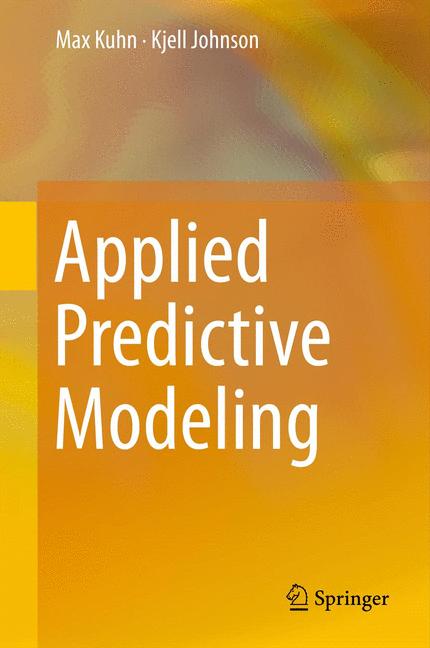
Applied Predictive Modeling
☆☆☆☆☆
(0 reviews)
Lowest price (incl. delivery)
6 892,00 JPY
Typical price50,28 PLN
Lowest (90 days)50,28 PLN
Offers3
Last updated17 часов назад
| Продавец | Product price | Delivery | Всего | Наличие | Updated | |
|---|---|---|---|---|---|---|
| SP SpringerNatureLink Shop INT | 6 863,00 JPY | 29,00 JPY | 6 892,00 JPY | Доступно | 17 часов назад | View offer |
| SP Springer Nature Author | 50,28 EUR | free | 50,28 EUR | Доступно | 1 неделю назад | View offer |
| SP SpringerNatureLink Shop INT | 56,50 EUR | 25,00 EUR | 81,50 EUR | Доступно | 1 день назад | View offer |
Цены и наличие могут меняться. Последнее обновление: 15.08.2026 07:46.
EAN
9781461468493
Springer Nature
0,0
☆☆☆☆☆
0 reviews
5★
0%
4★
0%
3★
0%
2★
0%
1★
0%
Product reviews
No reviews yet — be the first!
Applied Predictive Modeling covers the overall predictive modeling process, beginning with the crucial steps of data preprocessing, data splitting and foundations of model tuning. The text then provides intuitive explanations of numerous common and modern regression and classification techniques, always with an emphasis on illustrating and solving real data problems. The text illustrates all parts of the modeling process through many hands-on, real-life examples, and every chapter contains extensive R code for each step of the process. This multi-purpose text can be used as an introduction to predictive models and the overall modeling process, a practitioner’s reference handbook, or as a text for advanced undergraduate or graduate level predictive modeling courses. To that end, each chapter contains problem sets to help solidify the covered concepts and uses data available in the book’s R package. This text is intended for a broad audience as both an introduction to predictive models as well as a guide to applying them. Non-mathematical readers will appreciate the intuitive explanations of the techniques while an emphasis on problem-solving with real data across a wide variety of applications will aid practitioners who wish to extend their expertise. Readers should have knowledge of basic statistical ideas, such as correlation and linear regression analysis. While the text is biased against complex equations, a mathematical background is needed for advanced topics.
Similar products
 Gamma Knife Neurosurgery in the Management of Intracranial Disorders
from $210.78
Gamma Knife Neurosurgery in the Management of Intracranial Disorders
from $210.78
 SDGs in Construction Economics and Organization
from $210.78
SDGs in Construction Economics and Organization
from $210.78
 Emerging Therapies in Neurorehabilitation III
from $210.78
Emerging Therapies in Neurorehabilitation III
from $210.78
 Ground Improvement Techniques
from $220.36
Ground Improvement Techniques
from $220.36
 Anomaly Detection in Video Surveillance
from $220.36
Anomaly Detection in Video Surveillance
from $220.36
 Mechanism and Machine Science
from $287.42
Mechanism and Machine Science
from $287.42
 Protein-Protein Interactions as New Drug Targets
from $287.42
Protein-Protein Interactions as New Drug Targets
from $287.42
 Proceedings of the 7th International Conference of Transportation Research Group of India (CTRG 2023
from $287.42
Proceedings of the 7th International Conference of Transportation Research Group of India (CTRG 2023
from $287.42