
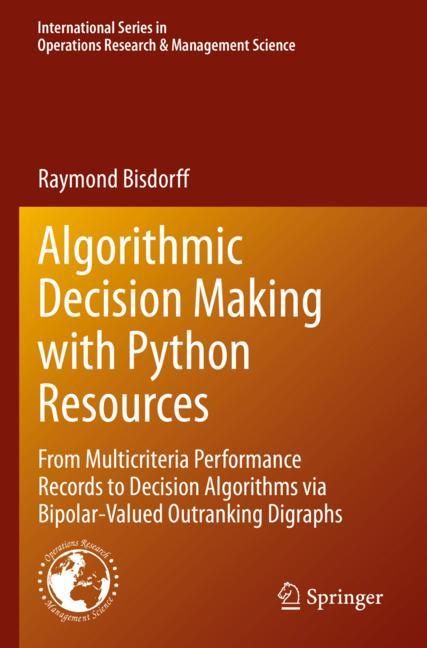
Algorithmic Decision Making with Python Resources
☆☆☆☆☆
(0 reviews)
Lowest price (incl. delivery)
98,19 EUR
Typical price86,96 PLN
Lowest (90 days)83,19 PLN
Offers2
Last updated17 часов назад
| Продавец | Product price | Delivery | Всего | Наличие | Updated | |
|---|---|---|---|---|---|---|
| SP Springer Nature Author | 83,19 EUR | 15,00 EUR | 98,19 EUR | Доступно | 9 часов назад | View offer |
| SP SpringerNatureLink Shop INT | 94,50 EUR | 25,00 EUR | 119,50 EUR | Доступно | 17 часов назад | View offer |
Цены и наличие могут меняться. Последнее обновление: 08.08.2026 13:19.
EAN
9783030909307
Springer Nature
0,0
☆☆☆☆☆
0 reviews
5★
0%
4★
0%
3★
0%
2★
0%
1★
0%
Product reviews
No reviews yet — be the first!
This book describes Python3 programming resources for implementing decision aiding algorithms in the context of a bipolar-valued outranking approach. These computing resources, made available under the name Digraph3, are useful in the field of Algorithmic Decision Theory and more specifically in outranking-based Multiple-Criteria Decision Aiding (MCDA). The first part of the book presents a set of tutorials introducing the Digraph3 collection of Python3 modules and its main objects, such as bipolar-valued digraphs and outranking digraphs. In eight methodological chapters, the second part illustrates multiple-criteria evaluation models and decision algorithms. These chapters are largely problem-oriented and demonstrate how to edit a new multiple-criteria performance tableau, how to build a best choice recommendation, how to compute the winner of an election and how to make rankings or ratings using incommensurable criteria. The book’s third part presents three real-world decision case studies, while the fourth part addresses more advanced topics, such as computing ordinal correlations between bipolar-valued outranking digraphs, computing kernels in bipolar-valued digraphs, testing for confidence or stability of outranking statements when facing uncertain or solely ordinal criteria significance weights, and tempering plurality tyranny effects in social choice problems. The fifth and last part is more specifically focused on working with undirected graphs, tree graphs and forests. The closing chapter explores comparability, split, interval and permutation graphs. The book is primarily intended for graduate students in management sciences, computational statistics and operations research. The chapters presenting algorithms for ranking multicriteria performance records will be of computational interest for designers of web recommender systems. Similarly, the relative and absolute quantile-rating algorithms, discussed and illustrated in several chapters, will be of practical interest to public and private performance auditors.
Similar products
 Gamma Knife Neurosurgery in the Management of Intracranial Disorders
from $210.78
Gamma Knife Neurosurgery in the Management of Intracranial Disorders
from $210.78
 SDGs in Construction Economics and Organization
from $210.78
SDGs in Construction Economics and Organization
from $210.78
 Emerging Therapies in Neurorehabilitation III
from $210.78
Emerging Therapies in Neurorehabilitation III
from $210.78
 Ground Improvement Techniques
from $220.36
Ground Improvement Techniques
from $220.36
 Anomaly Detection in Video Surveillance
from $220.36
Anomaly Detection in Video Surveillance
from $220.36
 Mechanism and Machine Science
from $287.42
Mechanism and Machine Science
from $287.42
 Protein-Protein Interactions as New Drug Targets
from $287.42
Protein-Protein Interactions as New Drug Targets
from $287.42
 Proceedings of the 7th International Conference of Transportation Research Group of India (CTRG 2023
from $287.42
Proceedings of the 7th International Conference of Transportation Research Group of India (CTRG 2023
from $287.42